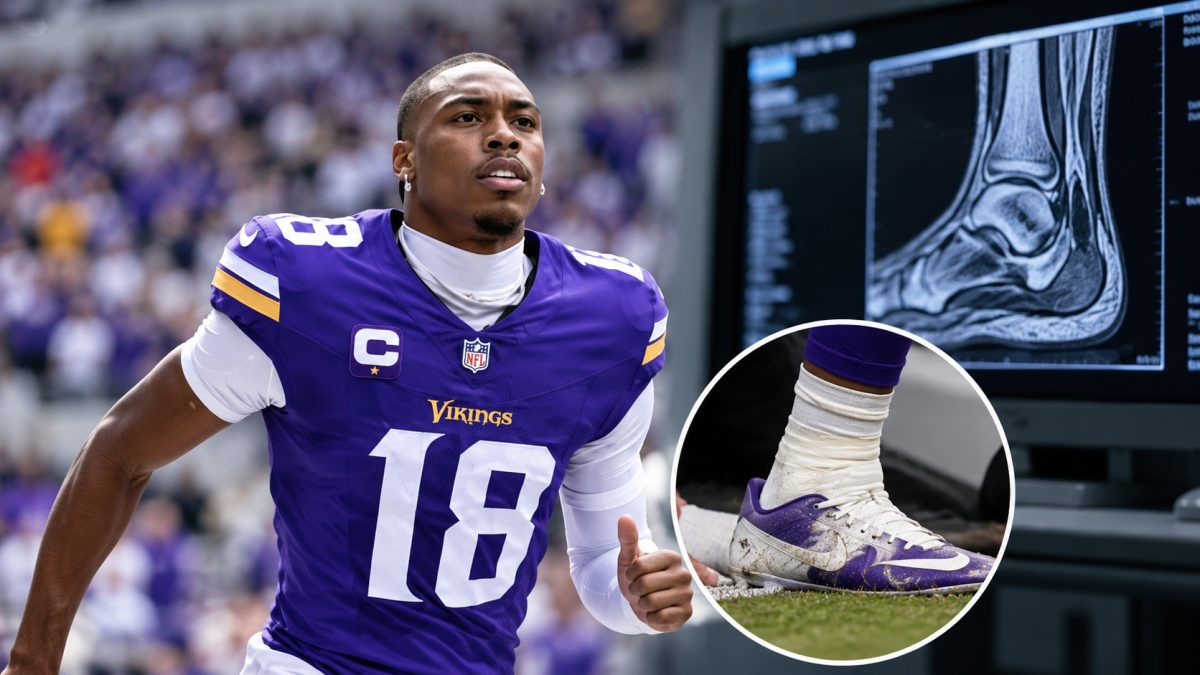

An MRI revealed an ankle sprain rather than a severe injury, giving the Vikings star wide receiver a realistic chance to face Miami this weekend.
Minnesota Vikings wide receiver Justin Jefferson suffered a right-ankle injury during the first quarter of Minnesota's 23-16 victory over the Tampa Bay Buccaneers on Sunday, Sept. 27, at Raymond James Stadium in Tampa, and the two-time All-Pro did not return to the game. A Monday MRI identified the injury as an ankle sprain, and sources told ESPN's Dan Graziano and NFL Network's Ian Rapoport that Jefferson has a chance to play when the Vikings host the Miami Dolphins in Week 4, though no official designation or medical clearance had been announced as of the latest reporting.
49ers Sign Brandin Cooks to Practice Squad as Injuries Gut Their Receiver Room
How the Injury Unfolded in Tampa
View this post on Instagram
Jefferson's injury occurred on Minnesota's opening possession when a defender fell onto his ankle, according to multiple reports including The Athletic. He had appeared to start the game normally, catching two passes for 33 yards, including a 10-yard screen, before the collision forced him from the field. The Athletic reported that Jefferson played only six snaps before he was ruled out during the third quarter, having initially been listed as questionable to return.
Jefferson first visited the sideline medical tent, according to Yahoo Sports, before briefly reappearing on the sideline with both ankles taped. He never re-entered the contest. The Vikings went on to control the game against Tampa Bay despite the loss of their top offensive weapon, improving to 3-0 on the season with the seven-point win.
Western Michigan President Won't Appeal Controversial Michigan Hail Mary Loss
O'Connell's Postgame Assessment and the Push-Off Problem
Head coach Kevin O'Connell addressed Jefferson's status in his postgame press conference, offering a measured but encouraging tone. "He tried to work through it. Got close a couple times," O'Connell said, according to NBC Sports. "Ended up being ruled out. We'll evaluate him more tomorrow."
O'Connell's comments pointed to a specific functional limitation rather than a diagnosed severe injury: Jefferson could not generate the push-off needed to run routes and separate from defenders effectively. That detail carries significance beyond the sideline drama, since a receiver's ability to cut, accelerate and push off is central to his on-field value, meaning even a comparatively minor sprain could still limit his effectiveness if he suits up against Miami. The coach's decision to hold Jefferson out, rather than risk aggravation, reflected a cautious approach during a game Minnesota was already positioned to win.
MRI Results Shift the Outlook
The Monday MRI provided the first concrete diagnostic data point since Jefferson left the field. According to ESPN and NFL Network reporting, the imaging confirmed an ankle sprain, and sources described the injury to both outlets as carrying a realistic chance for Jefferson to play in Week 4. Rapoport went further on social media, characterizing the injury as not "anything long-term" and stating that Jefferson could play against the Dolphins.
Minnesota Star Tribune reporter Ben Goessling added that the injury "didn't sound terribly serious initially," according to NBC Sports, reinforcing the cautiously optimistic tone emerging from multiple outlets. However, the available reporting stops short of a definitive medical grade or ligament-specific diagnosis. One outside injury analyst floated the possibility of a mild deltoid-ligament sprain, but that characterization was not attributed to the Vikings organization and should be treated as speculative analysis rather than a team-confirmed diagnosis.
What Remains Unresolved Ahead of Miami
Despite the encouraging MRI news, Jefferson's status for Sunday's home game against the Dolphins remains formally undecided. NBC Sports reported that his availability is "still yet to be determined," with the Vikings expected to base their final call on his recovery progress, additional testing and his ability to participate in practice throughout the week. No official designation — active, questionable or out — had been issued in the reporting reviewed.
The matchup itself adds context to Minnesota's decision-making, though not a medical rationale. NBC Sports described Miami's pass defense as fantasy-friendly, an attractive scenario if Jefferson is cleared to play, while also noting the Dolphins' offense has struggled following the loss of a star player to a torn ACL. Those competitive factors could theoretically influence how aggressively Minnesota manages Jefferson's workload, but they do not indicate the team will either rest or rush him back.
Vikings' Path Forward on Managing Their Star Receiver
With the Vikings sitting at 3-0, Minnesota has some flexibility to be patient with Jefferson's recovery timeline without jeopardizing its early-season position. Practice participation reports later in the week are expected to serve as the clearest signal of his trajectory, since his push-off mechanics — not merely pain tolerance — were the deciding factor in his removal against Tampa Bay.
Options available to the coaching staff include limiting Jefferson's practice repetitions, using a pregame workout to test his mobility, or reducing his snap count and route tree if he is active Sunday. None of those measures have been confirmed as the team's plan, and they remain reasonable projections based on standard NFL injury management rather than announced Vikings strategy. What is established is the sequence of events: an ankle sprain diagnosed by MRI, no long-term concern reported by league sources, and a decision on Jefferson's Week 4 availability still pending as Minnesota prepares to host Miami.