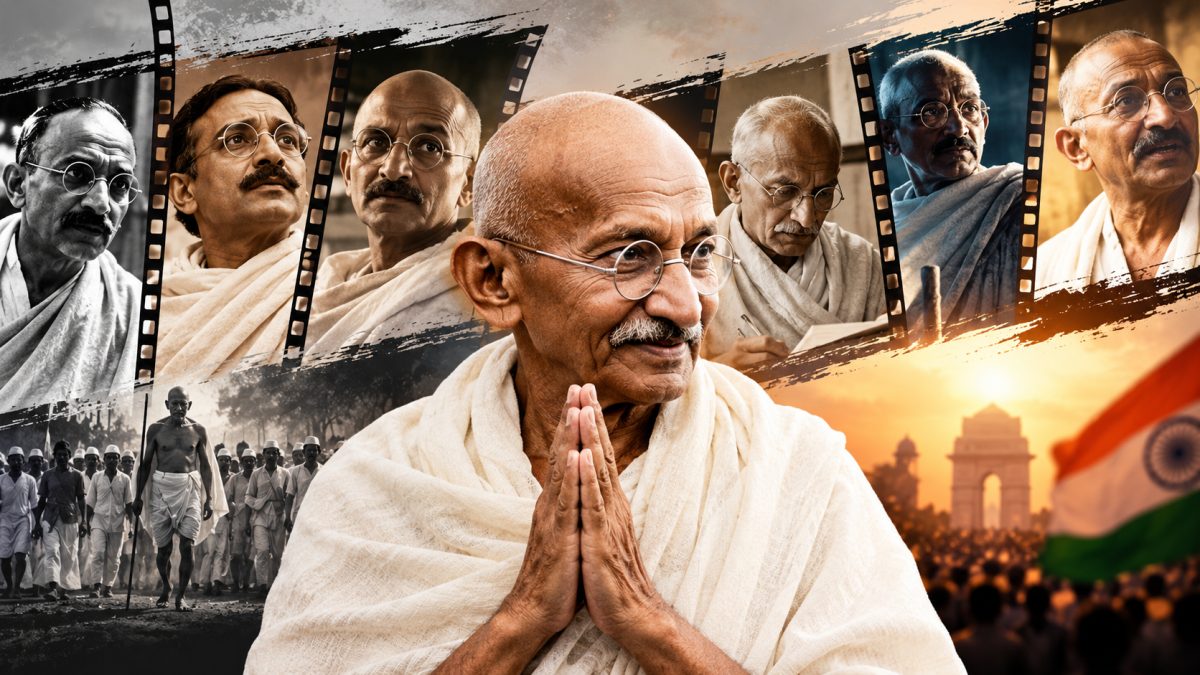

From Richard Attenborough's Oscar-sweeping epic to a son's bitter memoir and a comic reinvention, cinema's Gandhi is never just one man.
Gandhi Jayanti 2026 falls on Friday, October 2, marking the 157th birth anniversary of Mohandas Karamchand Gandhi, who was born on October 2, 1869, in Porbandar, Gujarat. Ahead of the observance, a Mashable India feature published October 1 compiled a list of films that collectively examine Gandhi's politics, personal relationships and enduring cultural weight, positioning cinema as a tool for understanding a figure whose legacy remains both revered and contested across India.
Anne Hathaway's Sheer 'Baby Bump Window' Outfit Caps a Bold Pregnancy Style Run
The Attenborough Epic That Defined Gandhi for the World
The most frequently cited recommendation remains Richard Attenborough's 1982 film Gandhi, a British-Indian production starring Ben Kingsley in the title role, with Rohini Hattangadi as Kasturba Gandhi, Roshan Seth as Jawaharlal Nehru and Amrish Puri in support. Directed and produced by Attenborough and written by John Briley, the film released in India on November 30, 1982, and traces Gandhi's transformation from a young barrister into the central figure of India's anti-colonial movement, according to Wikipedia's documentation of the production.
The narrative opens in South Africa, where Gandhi's confrontation with racial discrimination shapes his development of satyagraha, or truth-force. Its signature sequence depicts the 1893 incident at Pietermaritzburg, where Gandhi is thrown off a train for refusing to vacate a whites-only compartment, a scene Hindustan Times' retrospective on Gandhi films identifies as the picture's defining dramatic anchor. The story then follows his return to India, the campaigns of civil disobedience, communal tensions during Partition, and concludes with his 1948 assassination and funeral.
The film's institutional stature is difficult to overstate: it collected 11 Academy Award nominations and won eight Oscars, including Best Picture, Best Director for Attenborough and Best Actor for Kingsley, according to Britannica's entry on the film, which also notes five Golden Globe wins. Times of India's retrospective on Bollywood's Gandhi films wryly observes that "the best film on Bapu is made by a foreign filmmaker, starring a Hollywood actor," a line that underscores the film's dual identity as both landmark and outsider's lens, shaped by its English-language, British-led production framework rather than an exclusively Indian vantage point.
Spider-Man: Brand New Day Digital Release Date Sparks Confusion as Sony Stays Silent
Benegal's South African Prequel and the Making of a Leader
Shyam Benegal's 1996 film The Making of the Mahatma offers a distinctly Indian counterpoint, starring Rajit Kapur as Gandhi and Pallavi Joshi in a leading role. Based on Fatima Meer's book The Apprenticeship of a Mahatma, the film concentrates on the roughly 21 years Gandhi spent in South Africa, according to details compiled by Newsable Asianet News, treating that period as the crucible in which his political methods were forged rather than merely a preface to his Indian career.
In South Africa, Gandhi confronted discriminatory legislation targeting the Indian community and developed techniques of nonviolent resistance, collective organisation and civil disobedience that would later define the independence struggle. The film functions chronologically as a prequel to Attenborough's narrative, emphasising experimentation and intellectual formation over the fully realised national leadership depicted in the 1982 production. For viewers seeking a chronological entry point, The Making of the Mahatma precedes Gandhi in historical sequence, even though it was released 14 years later.
A Father's Failures: The Private Cost of Public Greatness
Feroz Abbas Khan's Gandhi, My Father, released August 3, 2007, turns toward the family rupture largely absent from the grander biopics. The film stars Akshaye Khanna as Harilal Gandhi, Gandhi's eldest son, Darshan Jariwala as Gandhi, and Shefali Shah in a principal role, drawing on biographical material documented by Myvi.in's survey of Gandhi cinema.
The film dramatizes the strained bond between Gandhi and Harilal, framing the tension between Gandhi's demanding moral and political commitments and his failures as a father. Rather than reinforcing Gandhi's image as an unblemished national icon, the film foregrounds Harilal's disappointments and estrangement, suggesting that Gandhi's public ideals carried unresolved private costs. Its historical value lies precisely in this discomfort — a reminder that reverence and domestic grievance coexisted within the same household.
Symbol, Satire and Assassination: Gandhi as Cultural Shorthand
Beyond straightforward biography, several films treat Gandhi as a living ethical reference rather than a historical subject. Amit Rai's Road to Sangam (2009), starring Paresh Rawal and Om Puri, uses a contemporary story involving Gandhi's ashes and a Muslim mechanic to probe communal coexistence, as noted in GQ India's streaming roundup. Rajkumar Hirani's Lage Raho Munna Bhai (2006) reimagines Gandhian philosophy through comic visions experienced by its protagonist, popularising the term "Gandhigiri" for a post-liberalisation audience.
Kamal Haasan's Hey Ram (2000) takes a darker route, following a character whose trauma and communal hatred draw him into the conspiracy to assassinate Gandhi, confronting the ideological radicalisation surrounding Partition. Prakash Jha's Satyagraha (2013) borrows the language of civil resistance for a fictional contemporary anti-corruption struggle, per GQ India's listing, while Ashutosh Gowariker's Swades (2004), though not a biopic, is frequently discussed alongside Gandhian themes of rural service and responsibility.
These seven titles split clearly along two lines: biographical dramas grounded in verifiable episodes — Gandhi, The Making of the Mahatma and Gandhi, My Father — and symbolic works using Gandhi as a moral catalyst rather than a historical record. Gandhi Jayanti is observed nationally each October 2, a date the United Nations also marks as the International Day of Non-Violence, giving the 2026 anniversary a dual resonance that the Mashable list uses as its occasion, even as the underlying question the films pose — whether Gandhi is best remembered as freedom fighter, philosopher, father or contested symbol — remains unresolved by any single screen portrait.