
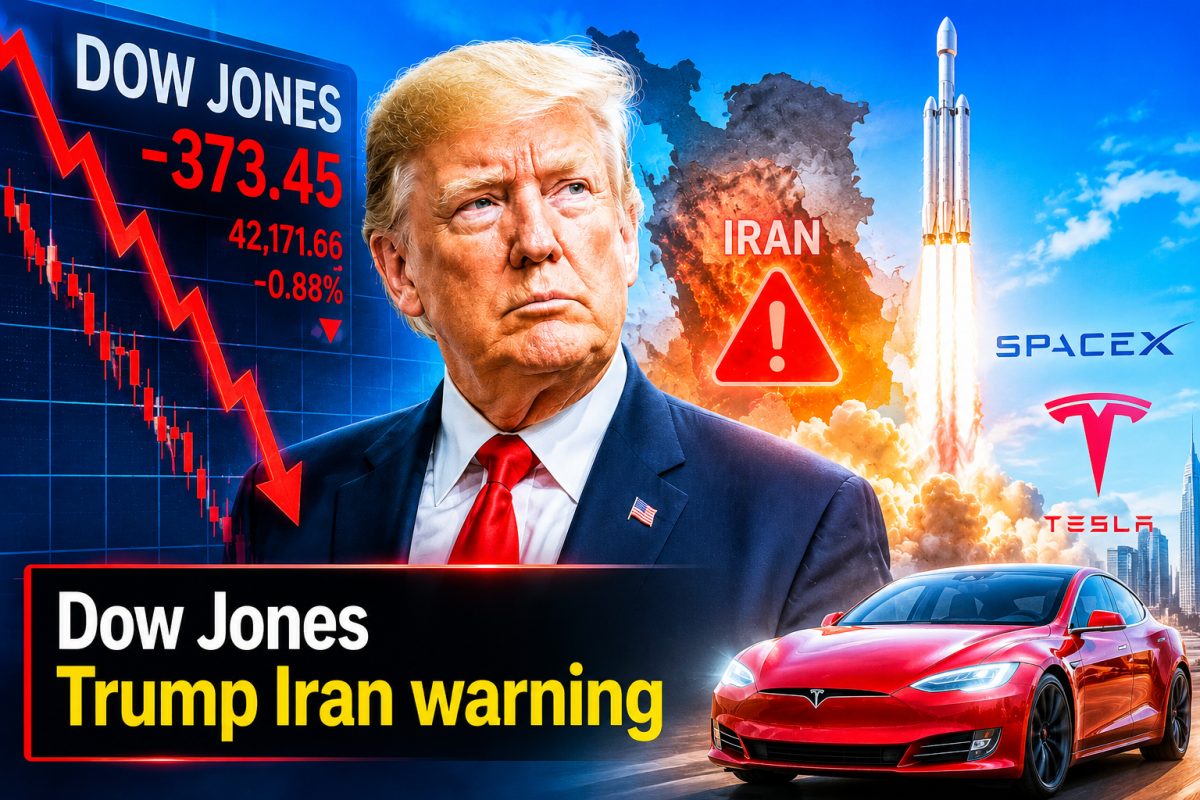

Dow futures steady after Trump's Iran warning triggers sharp Monday sell-off, while Elon Musk's SpaceX and Tesla defy the downturn.
The Dow Jones Industrial Average declined 373 points on Monday, August 31, 2026, after President Donald Trump threatened a forceful response to Iran's retaliatory strikes on U.S. bases in Jordan, according to Investor's Business Daily. Despite the broad market losses tied to the geopolitical warning, shares of Elon Musk-led SpaceX and Tesla rallied against the trend. Futures for the Dow, S&P 500 and Nasdaq traded little changed heading into Tuesday's session, signaling a tentative pause after the sell-off.
The decline came as Trump vowed "a response" to Iran following the strikes on U.S. bases in Jordan, IBD reported, framing his comments as the primary catalyst for Monday's losses. The warning added to a string of Trump statements on Iran throughout 2026 that have repeatedly rattled markets, alternating between threats of military action and expressions of optimism about renewed negotiations.
Trump's Warning And The Jordan Strikes
According to IBD's coverage, Trump's comments followed Iranian retaliatory strikes on U.S. bases in Jordan, prompting the president to signal that Washington would respond. The statement fits a pattern documented across IBD's market reporting this year, in which Trump's rhetoric on Iran has become a direct and repeated driver of single-day swings in major indexes.
Earlier episodes referenced in IBD's coverage illustrate the pattern. In April, Trump's "Iran war speech" promising to hit Iran "hard" sent Dow futures tumbling as oil prices skyrocketed. In August, Trump's threat to bomb Oman if it "gets in the way" of U.S.-Iran matters coincided with a 272-point Dow decline. In July, Trump said Iran "will pay" for killing American soldiers, a remark that preceded a more than 300-point drop in the Dow. Each instance shows markets reacting swiftly to presidential statements on the conflict, regardless of whether the tone was escalatory or conciliatory.
Indexes Slide, Futures Stabilize Overnight
Monday's 373-point Dow decline represented one of the sharper single-day losses in this recurring pattern of Iran-driven volatility, IBD reported. The exact moves in the S&P 500 and Nasdaq Composite were not fully detailed in available snippets, but IBD's framing indicates the sell-off extended across the broader market rather than being confined to the Dow alone.
By early Tuesday, futures tied to the Dow, S&P 500 and Nasdaq were described as trading little changed ahead of the open, suggesting investors were pausing to assess whether the prior day's selling would continue or reverse. This overnight pattern of sharp cash-market losses followed by muted futures has appeared repeatedly in IBD's Iran-related coverage throughout the year, often serving as an early signal of whether a geopolitical shock will have lasting market impact or prove short-lived.
SpaceX And Tesla Buck The Downturn
Even as the broader market fell, shares of SpaceX and Tesla rallied, according to IBD's headline and coverage. SpaceX, which trades on the Nasdaq under the ticker SPCX following a record initial public offering in June 2026, has repeatedly shown strength on days tied to U.S.-Iran headlines, at times outpacing the wider market regardless of whether the news was viewed as positive or negative for stocks generally.
Tesla, led by Musk alongside SpaceX, has similarly featured as a standout performer in IBD's recurring coverage of Iran-related market swings. On several occasions this year, including in June when the U.S. and Iran announced a deal to end hostilities, Tesla was cited among the session's biggest winners. The August 31 rally places Tesla in a similar position, gaining ground even as the Dow absorbed a 373-point loss tied directly to Trump's warning.
IBD did not detail specific catalysts behind Monday's moves in SpaceX or Tesla shares beyond noting the rally occurred alongside the broader market's decline. The pattern is consistent with earlier sessions in which both companies drew investor interest independent of the day's dominant geopolitical narrative.
A Year Of Iran-Driven Market Swings
Monday's session adds to an extended sequence of U.S.-Iran developments that IBD has tracked closely throughout 2026, spanning threats, ceasefires, deal announcements and renewed hostilities. In March, Trump postponed a Strait of Hormuz deadline citing "productive" Iran war talks, sending futures sharply higher before Iran denied any negotiations were taking place. In April, Iran claimed control over the Strait of Hormuz, a reversal that sent crude oil prices jumping and futures lower.
By June, the tone shifted toward de-escalation, with Trump announcing a pending U.S.-Iran deal that sent the Dow to a record high and drove rallies in SpaceX, Tesla, Alphabet and Rocket Lab. That optimism proved fragile, as subsequent sessions saw renewed threats and warnings, including Trump's comment that Iran would be "living in hell" without a deal. Monday's warning following the Jordan strikes marks the latest swing back toward escalation, underscoring how closely tied equity market sentiment remains to the day-to-day trajectory of U.S.-Iran relations.