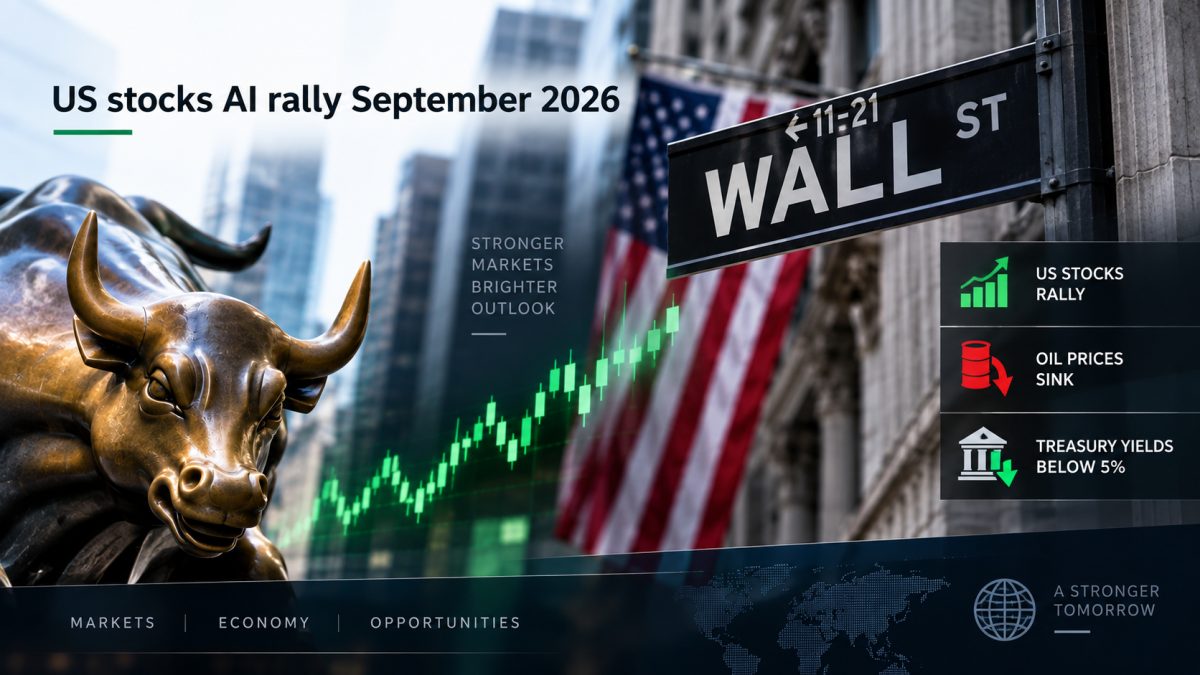


Major indexes closed out a winning week near record highs, but futures turned cautious as traders await inflation and jobs data that could reshape the Federal Reserve's rate path.
U.S. stock futures pointed modestly lower late Sunday, Sept. 27, 2026, following a week in which the S&P 500, Nasdaq Composite and Dow Jones Industrial Average all posted gains, with the Dow snapping a three-week losing streak. The pullback in futures ahead of Monday's trading session reflected investor caution rather than a reversal of sentiment, as markets shifted focus toward forthcoming inflation and labor-market reports that could influence the Federal Reserve's next moves on interest rates.
Wall Street Rises Friday as Hot Inflation Data Cements Fed Rate-Hike Bets
Friday's Rally and the Numbers Behind It
The retreat in futures followed a robust session on Friday, Sept. 25, when the Dow Jones Industrial Average surged 478.64 points, or 0.93%, to close at 51,828.62, according to data reported by Yahoo Finance and Reuters. The S&P 500 added 39.28 points, or 0.51%, finishing at 7,743.41, while the Nasdaq Composite rose 129.34 points, or 0.48%, to 27,068.72. Those gains capped a week in which the Nasdaq advanced roughly 2.1%, the S&P 500 climbed about 1.2%, and the Dow rose 0.3%, ending a three-week losing run for the blue-chip index, according to Investopedia and Yahoo Finance market summaries.
The S&P 500's weekly performance left the benchmark within roughly 0.7% of the record high it had set the previous month, underscoring that equities remained near historically elevated territory even after a volatile stretch. Reports from Yahoo Finance and Investors.com noted that the rally on Friday was broad enough to offset sharp swings earlier in the week, swings largely tied to a global bond-market sell-off and rising Treasury yields that had pressured growth stocks.
Oil Prices, Treasury Yields and the AI Trade
A cooldown in oil prices played a central role in easing market anxiety, according to reporting from Yahoo Finance and the Associated Press, as carried by WFTV. Lower energy costs reduced one potential source of additional inflationary pressure, helping to offset concerns that had built up over the preceding sessions amid the bond-market turbulence. Reuters reported that the improved tone on Wall Street reflected both the oil-price relief and continued investor enthusiasm for artificial-intelligence and semiconductor-related stocks, a dynamic that helped push the Nasdaq to the strongest weekly performance among the three major indexes.
Rising Treasury yields remained the underlying tension throughout the week. Higher yields increase borrowing costs for companies and households and can diminish the present-day value assigned to future corporate earnings, a mechanism that weighs disproportionately on high-growth technology firms whose valuations depend heavily on anticipated future profits. CNBC's live markets coverage from Sept. 24 had shown futures also under modest pressure a day earlier, with S&P 500 futures down 0.07%, Nasdaq-100 futures off 0.08%, and Dow futures lower by 0.06%, illustrating that the defensive positioning ahead of the new week was part of a broader pattern rather than an isolated move.
Wall Street Shrugs Off 5.23% Bond Yields as Falling Oil and AI Stocks Power Weekly Gains
Futures Signal Caution Ahead of the Trading Week
Heading into the Monday, Sept. 28 session, available market indications showed S&P 500 futures down roughly 0.1%, Nasdaq-100 futures lower by about 0.1%, and Dow futures fractionally weaker as well. The modest retreat suggested investors were entering the week defensively after a rally that had restored major indexes close to record levels, rather than signaling any decisive shift in sentiment. Schwab's market update from the same period showed intraday figures reflecting similar volatility, with the S&P 500 at 7,704.13, down 0.02%, and the Dow off 0.31% at one point during trading, reinforcing how quickly sentiment fluctuated even within a single session.
Some discrepancies emerged across data providers regarding the precise magnitude of Friday's gains. The Economic Times liveblog cited preliminary figures showing the S&P 500 up 0.49% to 7,742.09 and the Dow up 0.91% to 51,819.05, while Baystreet reported the Dow recovering 487.61 points to 51,828.59 and the S&P 500 climbing 39.38 points to 7,743.51. These minor variances reflect the routine differences between preliminary and final settlement data across financial news outlets, though the broader direction and scale of the rally were consistently confirmed.
What Investors Are Watching Next
The immediate calendar risk for markets was concentrated in upcoming inflation and employment data, reports that carry outsized importance given the market's current position near record highs alongside elevated bond yields. A hotter-than-expected inflation reading or stronger labor data could reinforce the case for the Federal Reserve to maintain restrictive interest rates, potentially pushing Treasury yields higher and pressuring equity valuations further. Conversely, softer economic readings could bolster expectations for eventual rate cuts and support continued demand for stocks, particularly in the technology sector.
For households and businesses, the stakes extend beyond Wall Street trading floors. Elevated Treasury yields translate into higher costs for mortgages, business loans and corporate financing, while a sustained equity rally supports retirement accounts and broader consumer confidence. Available reporting did not include verified direct quotations from Federal Reserve officials, corporate executives or named strategists specifically addressing the Sept. 27 futures move, meaning the market's next major reaction will hinge on how the incoming inflation and jobs figures compare with economist expectations, and what those numbers signal about the Federal Reserve's policy trajectory in the months ahead.