
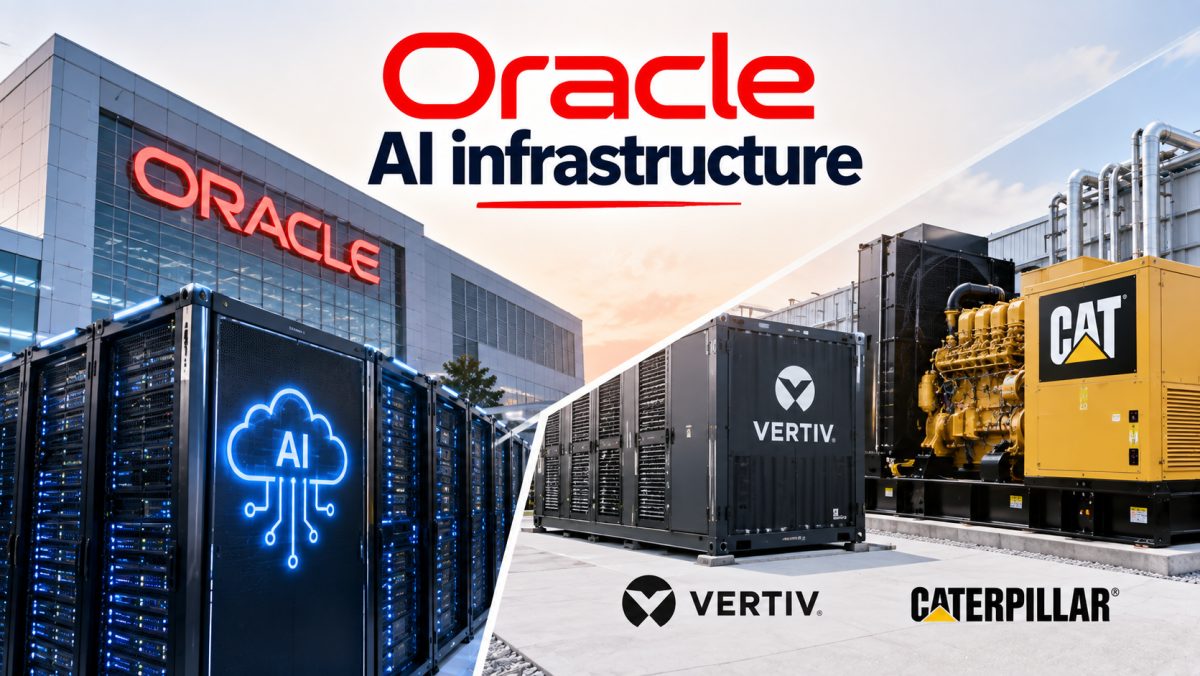

Oracle's transformation into an AI infrastructure giant is rippling outward, turning power-management firm Vertiv and industrial equipment maker Caterpillar into direct beneficiaries of the data center construction wave.
Oracle Corporation (NYSE: ORCL) has spent tens of billions of dollars building artificial intelligence data centers in recent quarters, a buildout so large that it is now reshaping the fortunes of companies far outside the software business, according to a Yahoo Finance analysis published September 20, 2026. The report identifies Vertiv Holdings (NYSE: VRT) and Caterpillar (NYSE: CAT) as two industrial suppliers positioned to profit from Oracle's data center expansion, framing all three companies as central players in what it calls an AI research boom.
AI Vibe-Coding Dispute Spreads Through Fan-Made N64 PC Recompilation Projects
Oracle's Pivot From Database Vendor to AI Infrastructure Giant
Oracle's quarter ended August 31, 2026, illustrates how dramatically the company's business has shifted. Total revenue reached $19.3 billion, up 30% year-over-year, while cloud infrastructure revenue jumped 121% to $7.4 billion, according to Oracle's Q1 FY2027 results reported September 11, 2026. Within that figure, CPU and GPU infrastructure revenue climbed 151% to $6.5 billion, and infrastructure revenue growth has now accelerated for nine consecutive quarters, rising from 52% in the fourth quarter of fiscal 2025 to 121% in the first quarter of fiscal 2027.
The scale of investment behind those numbers is substantial. Oracle spent $28.5 billion on capital expenditures in its latest quarter alone as it raced to build out cloud capacity for artificial intelligence, according to Yahoo Finance reporting from September 11, 2026. During the same period, the company brought roughly 850 megawatts of new AI capacity online, containing more than 300,000 GPUs, nearly triple the prior quarter's delivery, Bloomberg reported. Infrastructure utilization for AI workloads reached approximately 97.9%, with Oracle earning an average 20% premium on GPU renewal and resale contracts.
OpenAI Launches ChatGPT Personal Finance Tool as Privacy Experts Raise Alarms
Contracts Worth Hundreds of Billions Signal Durable Demand
Oracle booked more than $30 billion in new AI cloud contracts during the quarter ended August 31, 2026, pushing its remaining performance obligations to $664 billion, according to Yahoo Finance. That backlog follows an earlier quarter in which Oracle signed $67 billion in new AI infrastructure contracts, underscoring a pattern of accelerating enterprise and research-lab demand for OCI capacity.
Executives have defended the spending as a necessary response to that demand. During a Q2 2026 earnings call, Oracle said it would pour roughly $50 billion into capital investments to expand cloud and AI compute capacity during the current fiscal year, up from a $35 billion capital expenditure outlook the company had given for fiscal 2026 just months earlier, according to reporting from ChannelDive. Oracle has also expanded its footprint into new markets, including a May 1, 2026 agreement with the U.S. Department of War to deploy AI capabilities on classified networks across its cloud regions, alongside data center expansions in Texas, New Mexico, Wisconsin and Michigan.
Why Vertiv and Caterpillar Are Riding Oracle's Slipstream
The Yahoo Finance analysis describes Vertiv as operating "one layer below" Oracle's AI boom, supplying the power management and cooling systems that GPU-dense data centers require to function. As AI models grow larger and compute clusters draw more electricity, the thermal and energy challenges inside data centers intensify, creating sustained demand for Vertiv's equipment regardless of which specific AI models or applications ultimately succeed.
Caterpillar, long associated with construction and mining machinery, is cited as a beneficiary of the physical build-out itself. Large-scale data center campuses, such as Oracle's multibillion-dollar project in Michigan known as "The Barn," require earth-moving equipment, site preparation and backup power infrastructure. That project is tied to an expected $720 billion in hyperscaler AI spending across the industry in 2026, positioning Caterpillar and similar suppliers as beneficiaries of a construction cycle that extends well beyond any single cloud provider.
Investor Reaction and the Risks Behind the Boom
Markets have responded favorably to signs that Oracle's spending is being absorbed by real demand. Oracle shares rose about 6% in after-hours trading following the September 11, 2026 earnings release, and stock gained more than 2% on back-to-back trading days the following week even as the company simultaneously announced workforce reductions, according to Yahoo Finance. Bloomberg described the results as easing "buildout concerns" that had previously weighed on the stock.
Not every observer is convinced the spending is fully justified by current valuations. Oracle's free cash flow turned negative by roughly $5 billion in one recent period due to the pace of AI infrastructure investment, and separate Yahoo Finance analysis has questioned whether Oracle's stock price already reflects its growth runway, comparing it unfavorably in some respects to rival "picks-and-shovels" AI stock Broadcom. These are framed explicitly as investment opinions rather than settled facts, dependent on how AI research demand evolves over coming quarters.
What Comes Next for the AI Infrastructure Cycle
Oracle's $664 billion in remaining performance obligations suggests a multi-year pipeline of infrastructure work that would continue feeding demand to suppliers like Vertiv and Caterpillar regardless of near-term stock volatility. The company's expansion of OCI Enterprise AI, its sovereign cloud arrangement backed by SoftBank in Japan, and its classified cloud work with U.S. defense agencies point toward AI infrastructure spreading deeper into regulated industries and government sectors.
The central risk, acknowledged even within bullish coverage, is that this entire ecosystem depends on AI research momentum continuing at its current pace. A slowdown in enterprise AI adoption or a shift in capital markets' tolerance for heavy, sustained capital expenditure could pressure Oracle's valuation and, by extension, the order books of the industrial suppliers now tied to its fortunes. For now, accelerating infrastructure revenue, near-full utilization rates and a growing contracted backlog support the thesis that Oracle's AI buildout — and the demand it generates for power, cooling and heavy machinery — remains in its early stages rather than nearing a peak.