
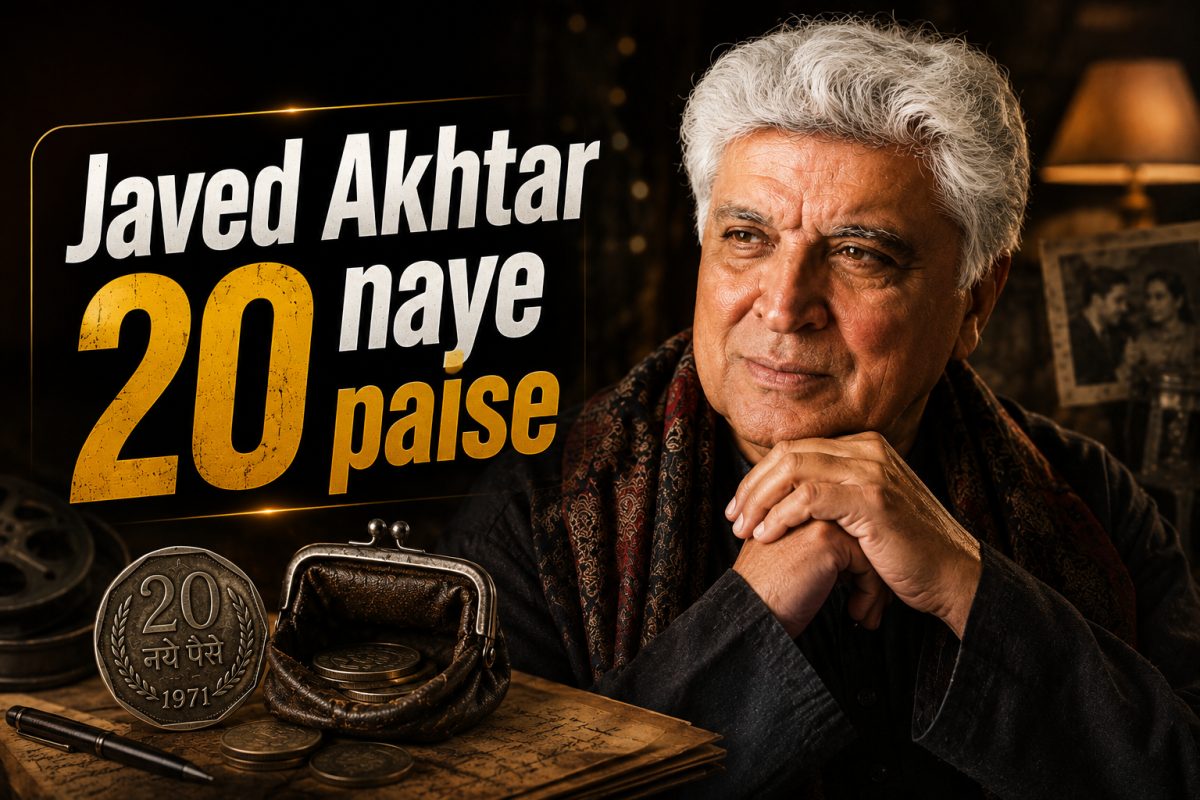

Veteran lyricist recounts a harrowing payday that never came, and the choice between a bus ticket and a meal.
Veteran lyricist and screenwriter Javed Akhtar has recalled an episode from his early struggle years in Bombay when a producer failed to pay him for writing work, leaving him with just 20 naye paise and forcing him to choose between transportation and food. The account was published by The Times of India on 29 August 2026 under the headline highlighting his statement, "Sometimes I had food, sometimes I didn't," and was corroborated by a separate Indian Express report the same day. The episode forms part of Akhtar's broader recollection of a six-year grind in Bombay, roughly from 1964 to 1970, before he rose to fame as one half of the legendary writer duo Salim-Javed.
According to the Indian Express account, Akhtar had once written around ten scenes for a film producer who promised to pay him Rs 1,000 the following day, a considerable sum for a struggling writer in that era. When Akhtar went to collect the payment at the producer's office in Dadar, he found it locked, with the producer nowhere to be found. At the time, Akhtar was living near Bandra-Khar and had just 20 naya paisa left in his pocket.
The Choice Between a Bus Ticket and a Meal
With only 20 naye paise remaining, Akhtar faced a stark decision. He could either use the money to buy a bus ticket from Dadar toward Bandra and walk the rest of the way home, or spend it on food and walk the entire distance instead. He chose to buy chana, roasted chickpeas, and then walked from Dadar all the way to Bandra.
Akhtar has said that during this period there were stretches when he went as long as three days without food, a detail that underscores just how precarious his situation had become. The Times of India headline captures this reality directly through his own words: "Sometimes I had food, sometimes I didn't." The anecdote has resurfaced repeatedly in his interviews and public reflections as a defining marker of his early years in the film industry.
Arrival in Bombay With 27 Naye Paise
The 20-paise incident sits within a longer, well-documented narrative of hardship that began when Akhtar first arrived in Bombay. He has recalled disembarking at Bombay Central station on 4 October 1964, at the age of 19, with just 27 naye paise in his pocket. In social media posts and interviews over the years, he has described this period as one marked by homelessness, starvation and unemployment, adding that when he looks back at his life today, he feels it has been "too kind" to him given how it began.
His early professional life offered little relief from that precarity. His first employer was filmmaker Kamal Amrohi, who paid him Rs 50 per month as an assistant, an amount lower than the Rs 80 earned by the office peon. When Amrohi's project stalled, Akhtar lost even that modest income, plunging him back into uncertainty. Throughout these years he relied heavily on ghostwriting dialogues, scenes and scripts for others, often without formal credit, and took on small, irregular assignments from producers and directors, some of whom, as in the 20-paise episode, failed to deliver on payment promises.
Why He Never Considered a Plan B
Central to both the Times of India and Indian Express accounts is Akhtar's explanation for why he never entertained a backup career or alternate livelihood, despite the recurring hunger and financial insecurity. He has framed his approach as one of total commitment to writing and cinema, suggesting that diluting his focus with an alternate plan was not something he could afford, financially or otherwise.
His wife, actor Shabana Azmi, has separately shared a similar account of his arrival in Bombay, describing him as a young man who came to the city with 27 naye paise and, in her words, a heart full of dreams. These recollections have circulated widely on social media and in interviews, often framed as commentary on the precariousness of freelance creative work within the mid-20th-century Bollywood studio system.
From Hardship to the Salim-Javed Partnership
Akhtar's fortunes changed significantly after he formed a writing partnership with Salim Khan, together known as Salim-Javed. The duo went on to write some of Hindi cinema's most influential films, helping define what became known as the "angry young man" era and reshaping mainstream storytelling in Bollywood.
Akhtar has repeatedly juxtaposed those early days of hunger and homelessness against his later success, using anecdotes like the 20-paise episode to illustrate both the severity of his struggle and the resolve that carried him through it. The story continues to be framed by news outlets as an inspirational, cautionary account of persistence in the creative industries, with no controversy or dispute attached to the incident itself.