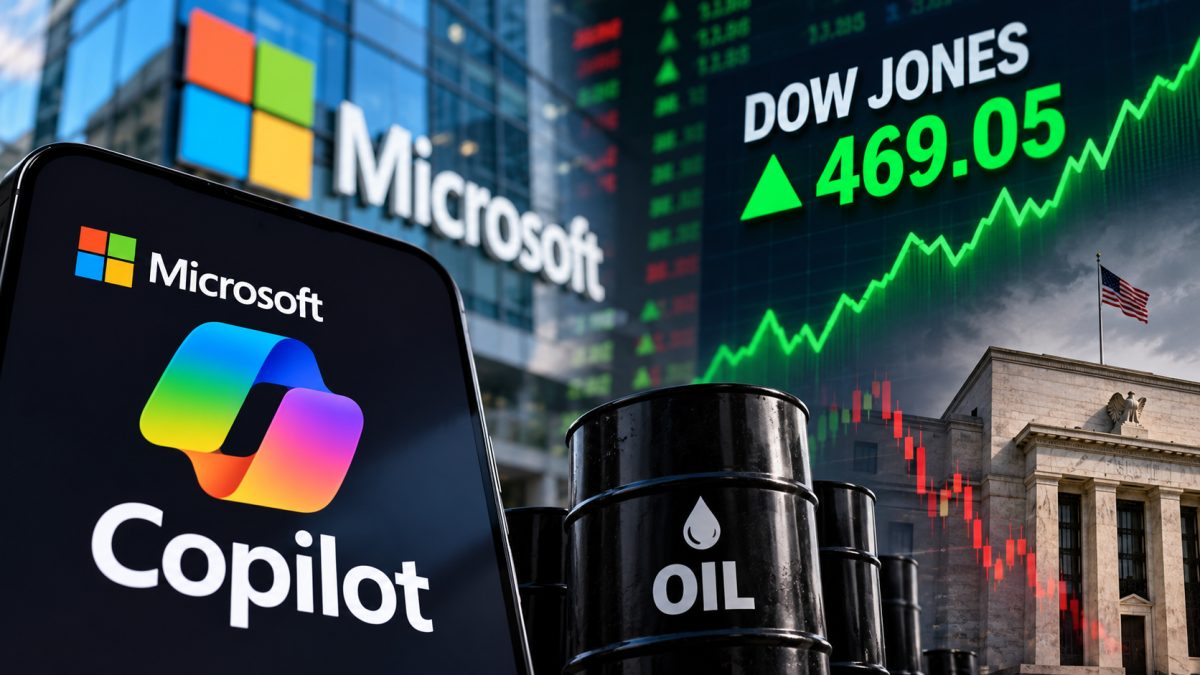

Microsoft's revamped Copilot platform ignited a broad tech rally on Wall Street even as elevated oil prices, surging bond yields and rising Federal Reserve rate-hike odds threatened to derail investor confidence.
Wall Street closed sharply higher on Friday, September 25, 2026, as investors piled into Microsoft and other artificial-intelligence-linked technology stocks, shrugging off a week of anxiety over elevated oil prices, a sharp rise in Treasury yields and growing bets on another Federal Reserve interest-rate increase in October. The Dow Jones Industrial Average jumped 469.07 points, or 0.91%, to finish at 51,819.05, capping a volatile week in which inflation fears and Middle East uncertainty had repeatedly pressured equities. The S&P 500 and Nasdaq Composite also ended in positive territory, extending gains that had been more modest earlier in the session.
Wall Street Retreats From Record Highs as 24-Year Treasury Yields Spook Investors
Microsoft's Copilot Overhaul Ignites the Rally
Microsoft shares rose roughly 3.3%, according to market data cited by Reuters and the Economic Times, after the company unveiled new capabilities for its Copilot artificial-intelligence platform, including a coding-oriented tool and an always-on AI agent designed to operate continuously rather than respond only to individual prompts. Investors.com reported the stock jumped as much as 4% intraday, breaking out from a technical pattern known as a cup base at 466.32, and MarketBeat noted Microsoft shares reached their highest closing level of the year on the news.
The announcement made Microsoft the single largest contributor to the S&P 500's gains for the session, according to the Economic Times and Reuters. Analysts framed the Copilot expansion as evidence that Microsoft is pushing generative AI beyond experimental pilot programs and into core commercial functions spanning software development, workplace productivity and persistent digital assistance. The renewed enthusiasm around Microsoft's product roadmap spilled over into the broader AI complex, lifting sentiment across technology shares even as macroeconomic headwinds persisted.
Wall Street Rallies as Dismal Jobs Report Crushes Odds of an October Fed Rate Hike
A Rebound After Three Sessions of Pressure
Friday's advance followed a difficult stretch for equities. On Thursday, September 24, the Dow fell 162.41 points, or 0.32%, to 51,349.18, while the S&P 500 slipped 2.20 points, or 0.03%, to 7,703.83, and the Nasdaq Composite eked out a marginal gain of 1.76 points, or 0.01%, to 26,937.79, according to Economic Times market data. That weakness stemmed from rising oil prices, selling pressure in the bond market and uncertainty tied to developments in the Middle East, as reported by Hindustan Times.
Notably, Microsoft declined on Thursday while Meta Platforms advanced, according to Reuters' company coverage, underscoring how uneven performance within the technology sector has become even as investors search for AI winners. Meta had already gained 36% during September through Thursday's close, driven by the launch of its Muse personal AI assistant. That surge, while illustrating investor appetite for concrete AI products, has also raised questions among market watchers about valuation sustainability and how durable such rapid gains can be.
Oil Prices and Treasury Yields Cloud the Outlook
Even as technology stocks rallied, oil and fixed-income markets remained central to the market's underlying tension. Brent crude eased early in Friday's session but stayed above $100 a barrel, while West Texas Intermediate traded near $92 a barrel, based on Schwab market data showing WTI at $92.54, down $2.07 on the day. Oil prices had climbed through the week on concerns over Middle East instability and potential disruption to energy supplies, a dynamic that matters to equity investors because expensive energy can intensify inflation, raise corporate operating costs, erode consumer purchasing power and complicate the Federal Reserve's ability to ease policy.
Treasury yields presented an equally significant obstacle. The benchmark 10-year Treasury note yield was reported near 5.2% on Friday, with Schwab data showing 5.17%, up 0.02 points. Earlier in the week the 10-year yield had climbed above 5%, reaching its highest level since 2007 in some market reports, according to Hindustan Times. The 30-year Treasury yield also rose to levels unseen since 2004, touching approximately 5.42% on Thursday. Elevated yields raise the return available on relatively low-risk government debt and increase the discount rate applied to future corporate earnings, a factor especially consequential for technology and AI companies whose valuations often hinge on long-term growth expectations.
Rate-Hike Odds Climb as Fed Meeting Nears
Interest-rate expectations shifted markedly during the week. The CME Group's FedWatch Tool showed traders assigning a 66.4% probability to the Federal Reserve raising rates by at least 25 basis points at its October meeting, up from roughly 50% earlier in the week. Other market coverage placed the probability near 66% during Friday morning trading, after it had reached as high as approximately 71% at points earlier in the week. These figures represent market-implied odds derived from futures pricing rather than any formal Fed commitment, and they remain subject to rapid revision as new inflation, labor-market and growth data emerge.
The rate debate is directly entangled with the moves in energy and bond markets. A sustained rise in oil prices could feed into headline inflation readings and complicate the central bank's policy calculus, while stronger-than-expected economic data and persistent Treasury selling have independently pushed yields higher. Investors are now weighing whether the Fed will need to hold policy restrictive, or tighten further, to prevent inflation from becoming entrenched — a question that will shape whether Friday's AI-driven optimism can be sustained into October.
What Comes Next for Markets
The session's gains mark a recovery after three consecutive days of pressure, led by the Dow and reinforced by large technology names betting on AI monetization. Yet the underlying risks that dominated the week remain unresolved. Market participants are now tracking three variables that will determine the durability of the rebound: whether oil prices hold above $100 a barrel, whether Treasury yields continue climbing toward multi-decade highs, and whether the Federal Reserve follows through with a rate increase at its October meeting.
Microsoft's Copilot rollout gave investors a company-specific reason to look past those macroeconomic pressures, but it did not eliminate them. As the broader market continues to test whether AI product launches and earnings growth can outweigh higher borrowing costs and inflation risk, Friday's rally stands as evidence of investor demand rather than a resolution of the deeper tension between technological optimism and macroeconomic caution.