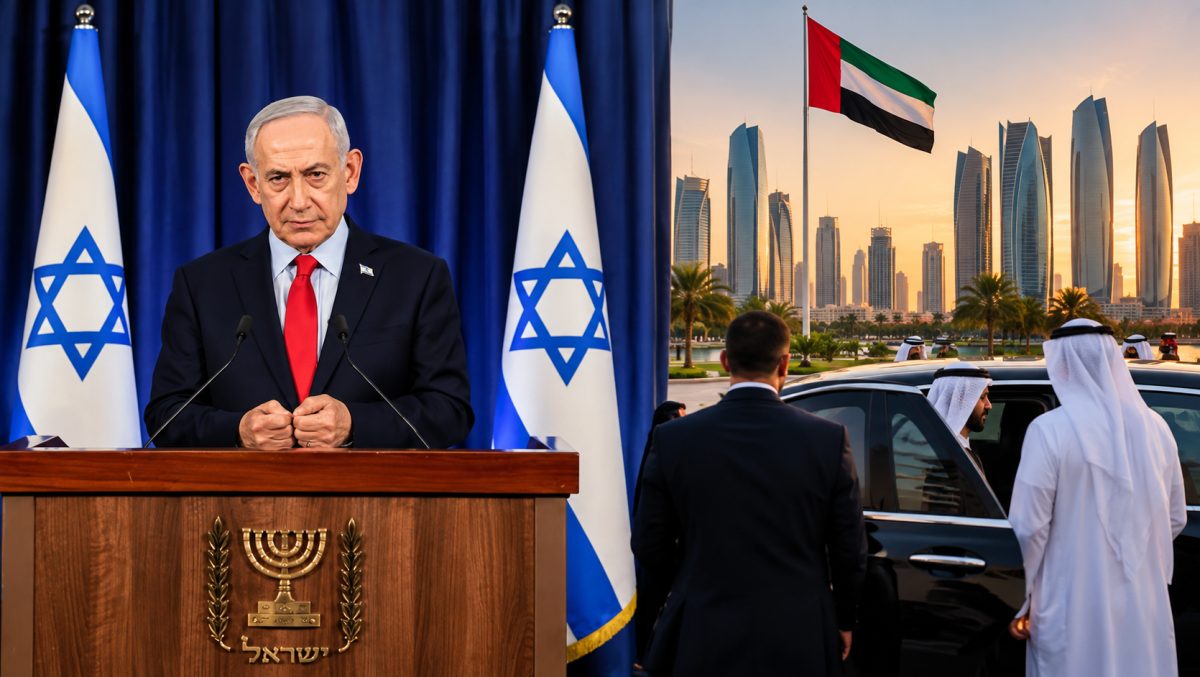

Israel and the UAE confirmed a previously secret hourlong meeting in Abu Dhabi that mixed Iran strategy with a politically explosive request tied to the Oct. 7 attack.
Israeli Prime Minister Benjamin Netanyahu made a previously undisclosed visit to Abu Dhabi on Sunday, Sept. 27, 2026, where he held an hourlong meeting with UAE President Sheikh Mohamed bin Zayed Al Nahyan, according to Israeli and Emirati officials who confirmed the encounter on Monday, Sept. 28. The trip, first reported by Israel's Channel 12, saw Netanyahu fly from Ben Gurion Airport shortly after noon aboard a private jet, spend roughly four hours in the UAE, and return to Israel the same evening, according to people briefed on the travel arrangements cited by The Associated Press and CNN.
Iran Fires Missiles at Kuwait and Bahrain After US Strikes
How the Secret Trip Came to Light
Neither government announced the visit in advance. Word emerged only after Channel 12 broke the story, prompting Israel and the UAE to issue confirmations on Monday. A senior Israeli official told Reuters that Netanyahu had visited Abu Dhabi and met Sheikh Mohamed on Sunday, while Israeli outlet Israel Hayom reported that Mossad chief accompanied Netanyahu on the journey, underscoring the security-sensitive nature of the trip.
The meeting was described by multiple outlets as occurring largely as a one-on-one conversation between the two leaders, a format that limited the number of officials aware of its contents in real time. The UAE's state news agency WAM said the two discussed "bilateral relations between the UAE and Israel and ways to strengthen and further develop them," while Netanyahu's office issued a near-identical formulation, describing talks on "strengthening relations between the two countries and regional challenges." Neither official statement referenced Iran directly or the Oct. 7 warning allegation.
Israeli Killed Near West Bank Settlement Hours Before Yom Kippur as Troops Kill Palestinian Motorist
The Oct. 7 Warning Allegation at the Center of the Visit
According to the AP, Netanyahu's underlying purpose for the trip was to ask Sheikh Mohamed to deny reports that the Emirati leader had warned him of an impending Hamas attack before the Oct. 7, 2023 assault on southern Israel. Two people briefed on the visit confirmed to AP that Netanyahu made this request directly to the UAE president. Netanyahu's office has denied that the Israeli prime minister ever received such a warning.
The allegation itself has circulated in reporting by The Wall Street Journal and The New York Times, feeding into a broader domestic reckoning in Israel over intelligence and political failures preceding the attack, in which Hamas and allied militants killed roughly 1,200 people and took about 250 hostages, according to Israeli tallies. Neither the UAE's official statement nor Israel's public account confirmed or addressed the warning claim, leaving it publicly unresolved even as it appears to have shaped the private agenda of the visit. The available reporting characterizes Netanyahu's request as information from people briefed on the meeting rather than an independently verified account of what, if anything, was actually communicated before Oct. 7.
Iran Dominated the Substantive Discussion
An Israeli source cited by CNN said the secret meeting was dominated by discussion of Iran, an area where Israel and the UAE have deepened security cooperation during the ongoing Iran war. This dimension carries weight beyond the bilateral relationship, touching on missile threats, regional militia activity and the protection of Gulf infrastructure that concerns both Abu Dhabi and Washington. The UAE has long sought to balance its security alignment with Israel and the United States against its economic and diplomatic footprint across the wider Middle East, a balancing act made more delicate by simultaneous conflicts involving Iran and Gaza.
No new agreement, treaty, financial commitment or military arrangement was announced publicly as a result of the meeting. The official language from both governments remained general, describing an intent to strengthen ties and address unspecified regional challenges. Israeli media separately circulated reports that Netanyahu met officials from other Middle Eastern countries lacking diplomatic relations with Israel during the same window, though the identities of any such officials, the countries involved, or the substance of those discussions have not been independently verified in available reporting.
A Fragile Relationship Under the Abraham Accords
Israel and the UAE have maintained formal diplomatic relations since the 2020 Abraham Accords, when the UAE became one of the first Arab states to normalize ties with Israel under U.S. brokerage. Since then, the two countries have built commercial, diplomatic and security cooperation, including coordination against Iran. But the relationship has operated under visible strain during the Gaza war, compounded by disagreements over Palestinian statehood and the postwar administration of Gaza.
Netanyahu's direct, secretive engagement with Sheikh Mohamed represents an unusually high-level and unusually quiet moment in that relationship, occurring while Israel remains engaged in active conflict and while the Oct. 7 accountability debate continues to roil Israeli politics. The lack of advance notice, paired with confirmation only after the fact, reflects how sensitive both governments considered the substance of the talks.
What Comes Next for Netanyahu and Regional Diplomacy
The immediate political consequence is likely to be renewed scrutiny of the pre-Oct. 7 warning controversy inside Israel. Should the UAE issue a direct public denial of the warning claim, it could hand Netanyahu political ammunition as he continues to face criticism over the attack's intelligence failures. Should Abu Dhabi decline to address the allegation publicly, the secrecy surrounding the visit may only deepen speculation about what exactly transpired between the two leaders.
Neither outcome would, on its own, resolve the wider questions still under examination in Israel regarding intelligence assessments, military readiness and government decision-making before the Hamas assault. For now, the confirmed record remains narrow: a secret same-day trip, an hourlong one-on-one meeting, public statements citing bilateral relations and regional challenges, and a disputed allegation that neither government has formally settled.