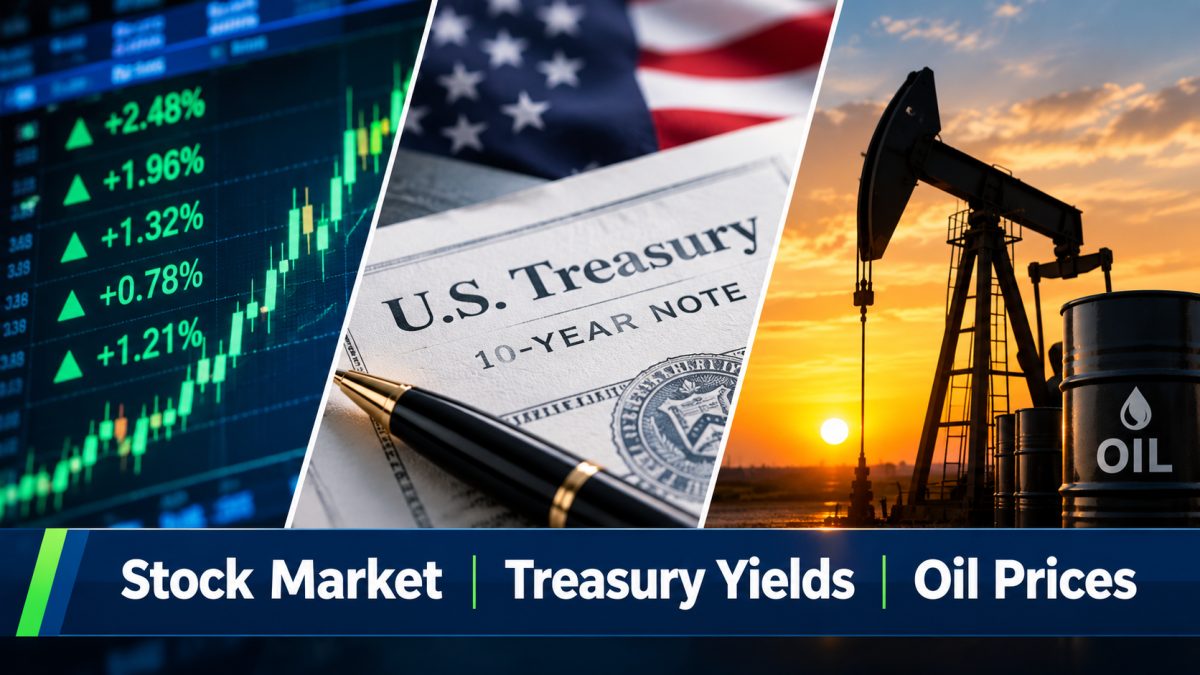

The Dow jumped more than 470 points and oil prices tumbled on hopes for eased Middle East tensions, but a bond-market selloff pushing yields to 19-year highs signals unresolved risks ahead.
U.S. stocks closed higher on Friday, September 25, 2026, capping a volatile week in which the Dow Jones Industrial Average gained more than 470 points and the S&P 500 and Nasdaq Composite also advanced, according to Wall Street Journal live coverage. The rally came even as the benchmark 10-year Treasury yield briefly touched approximately 5.23%, its highest level since 2007, and as crude oil prices swung sharply amid uncertainty over Iran-related geopolitical tensions.
Wall Street Roars Back as AI Fears Fade, Oil Sinks and Treasury Yields Break Below 5%
A Week Defined by Competing Forces
Reuters characterized the week's market dynamic as a contest between what it called "AI euphoria" and hopes for improved Middle East energy supplies on one side, and a surging bond selloff on the other. Global stocks were on pace for their best weekly performance since early August, Reuters reported, even as the U.S. 10-year yield climbed roughly 16 basis points over the week, according to Dow Jones data cited by The Wall Street Journal.
The tension played out unevenly across sessions. Thursday's trading showed the fragility beneath the surface: the S&P 500 finished nearly unchanged, the Nasdaq edged up just 0.01% to 26,939.37, and the Dow fell 0.31% to 51,349.98, according to Schwab market data. Microsoft slipped 0.5% and Broadcom lost 1.3% that day, while Advanced Micro Devices gained 2.4%, per figures reported by Metro Bank Wealth Insights, illustrating how uncertainty over Iran was rattling AI-linked names even as investors kept buying the broader theme.
Wall Street Rises Friday as Hot Inflation Data Cements Fed Rate-Hike Bets
Treasury Yields Hit Levels Unseen in Decades
The 10-year Treasury yield reached an intraday peak of 5.2297% on Friday, its highest since 2007, before retreating to around 5.19% and lower as the session progressed, according to data reported by the Economic Times and TradingView-sourced Dow Jones Newswires. The 30-year Treasury yield climbed even further into historic territory, touching roughly 5.5252% at one point Friday — its highest level since 2004 — before easing to around 5.46%, per Reuters' Wall St Week Ahead report.
The pressure was not confined to long-dated debt. Reuters noted the two-year Treasury yield stood near 4.90%, meaning investors were repricing risk across the entire yield curve simultaneously. That combination reflected worry both about the Federal Reserve's near-term policy path and about longer-run inflation, federal borrowing needs and the overall supply of Treasury debt hitting the market. Reuters described investors as "demanding greater compensation to hold U.S. government bonds" even as equities showed resilience.
Oil's Reversal Provides Relief
Crude oil supplied the most direct catalyst for Friday's stock rally. Brent crude fell more than 3% at one point, dropping below $97 a barrel, according to Dow Jones Newswires reporting via TradingView, while U.S. West Texas Intermediate crude also declined. Other outlets, including CNBC's earlier Thursday coverage, showed WTI dropping 2% to around $92 a barrel and Brent falling 1% to around $104, underscoring how quickly prices moved across the two trading sessions.
The decline traced directly to hopes that ongoing U.S.-Iran negotiations could ease the risk of supply disruptions, the TradingView report noted, as investors digested headlines about diplomatic contacts. Barron's live coverage similarly noted oil dipping below $100 a barrel as bond yields fell back from their overnight peaks. Still, Brent had traded above $100 a barrel earlier in the week amid concerns over shipping through strategically vital Middle East corridors, and Friday's pullback did not erase those underlying supply-risk concerns — it only reduced their immediate market impact.
Microsoft and AI Stocks Carry the Market
Technology shares, led by Microsoft, provided the backbone of Friday's advance. Reuters reported that Wall Street climbed as investors bought Microsoft and other AI-related stocks even while high oil prices and the Treasury yield surge kept traders on edge. In intraday trading cited by Reuters via AOL, the Nasdaq Composite rose about 0.50% to 27,073.90 while the Dow was up roughly 0.78% at 51,747.99.
That resilience reflects investors' continued willingness to pay premium valuations for companies tied to data-center expansion, semiconductor supply chains, cloud infrastructure and enterprise AI adoption — a dynamic strong enough to offset the discounting effect that higher bond yields typically impose on growth-stock valuations. But the offset has limits: if yields remain above 5% or push still higher, the present-value math underpinning richly priced technology shares could come under renewed strain, particularly for companies whose earnings growth is expected further into the future.
What Comes Next for Markets
Investors are now turning to the upcoming U.S. employment report and inflation readings, which Reuters' Wall St Week Ahead analysis identified as key tests for the Federal Reserve's rate path. A stronger-than-expected jobs report could reinforce arguments for keeping rates restrictive, while signs of labor-market cooling or softer inflation could pull yields lower and extend the equity rally — though both remain scenarios rather than confirmed outcomes.
Beyond trading floors, sustained high Treasury yields typically translate into higher mortgage rates, corporate borrowing costs and municipal debt costs, while elevated oil prices can raise gasoline and production expenses that squeeze household budgets. Friday's session showed markets can look past a historic yield spike when energy prices retreat and AI-driven optimism holds — but it did not resolve the geopolitical uncertainty over Iran or the structural bond-market pressures that drove yields to multi-decade highs in the first place.