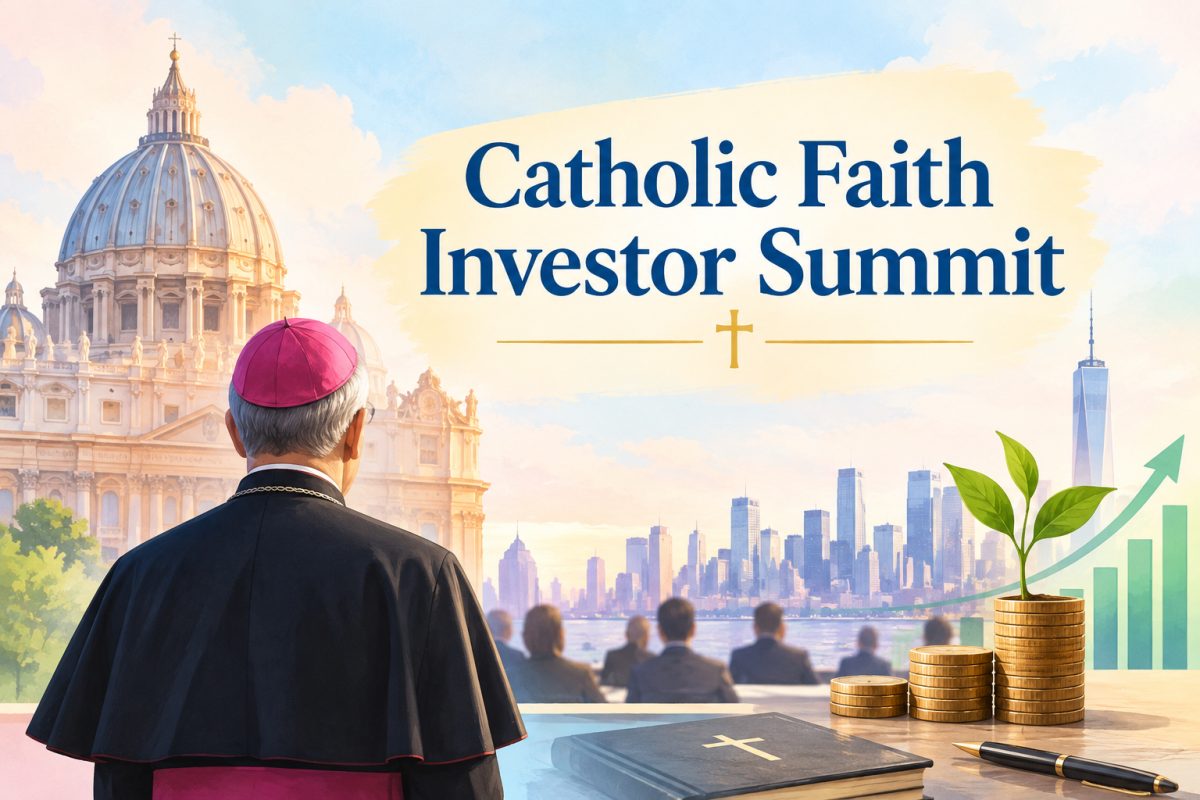

More than 100 financial professionals and Catholic leaders met at the New York Athletic Club to wrestle with a question increasingly facing dioceses: does faith belong in the portfolio, not just the pulpit?
The Catholic Faith Investor Summit convened more than 100 financial professionals, Catholic leaders and clergy in New York City on September 16-17, 2026, to examine how institutional investment can align with Catholic social teaching while still satisfying fiduciary duty. The second annual gathering, themed "Empowering Catholic Leaders to Align Their Investments with Their Faith and Create Impact," opened with Mass at St. Patrick's Cathedral before sessions moved to the New York Athletic Club at 180 Central Park South. The event was reported by Catholic World Report on September 25, though available material does not confirm a full transcript, audited attendance count or session-by-session record.
Four Global Agencies Raise India's Growth Forecast in One Day — Here's What Triggered the Rush
Why Dioceses Are Rethinking Where Their Money Sits
View this post on Instagram
The summit arrived as dioceses, religious orders and Catholic foundations face increasingly concrete questions about where their money is invested, how asset managers are monitored, and whether portfolio decisions reflect Church teaching on human dignity, the common good and economic justice. Organizers framed the event as a forum for bishops, chief investment officers, finance officials and institutional asset managers rather than a purely devotional gathering. Promotional material cited more than $250 billion in assets represented by participating Catholic institutions, though that figure is an organizer estimate, not an independently verified total. It remains unclear how many institutions contributed to that sum, whether it reflects assets under management or total institutional holdings, or how much is currently governed by formal Catholic investment mandates.
A central reference point throughout the discussions was Mensuram Bonam, a 2022 document from the Vatican's Pontifical Academy of Social Sciences. The document functions as a framework for faith-consistent investment rather than a binding legal or magisterial rule, applying Catholic social teaching to investor responsibilities and urging institutions to treat capital as a means of serving people and the common good rather than solely maximizing returns.
US Stocks Fall as Brent Crude Tops $100 Ahead of Inflation Data
The Exclusion, Engagement and Impact Framework
Summit discussions reportedly centered on a three-part approach summarized as exclusion, engagement and impact. Exclusion means avoiding companies or sectors deemed incompatible with Catholic principles, with abortion, pornography and gambling cited as examples discussed at the event. Engagement uses shareholder ownership to communicate with corporate management, vote on resolutions and press companies toward improved policies. Impact investing directs capital toward activities intended to produce measurable social or economic benefit, including financial inclusion, community development and investment in the real economy.
The framework's significance lies in treating divestment as one option among several rather than an automatic response. Instead of selling a problematic holding outright, an institution may first assess whether shareholder engagement can produce meaningful change. That choice depends on the nature of a company's activities, the investor's degree of influence, the likelihood of reform and the institution's own governing investment policy. Where engagement proves ineffective, or where an activity is considered fundamentally incompatible with Church teaching, exclusion becomes the preferred course. The U.S. Conference of Catholic Bishops' socially responsible investment guidelines reinforce this layered approach domestically, emphasizing avoidance of serious harm, promotion of positive social outcomes and pursuit of competitive financial returns as parallel objectives rather than competing priorities.
Balancing Doctrine Against Fiduciary Duty
Sessions at the summit examined how to evaluate individual companies against Catholic teaching, how to draft an investment policy statement that explicitly incorporates Catholic principles, and how to translate Mensuram Bonam into portfolio construction and manager oversight. Organizers described the stated objective as building a repeatable process for integrating moral analysis into due diligence, asset allocation, proxy voting and manager selection, rather than simply publishing a list of prohibited holdings.
That ambition sits atop a familiar tension for institutional investors: religious alignment cannot substitute for prudent stewardship, particularly where diocesan assets underwrite schools, parishes, charitable programs and pension obligations. Supporters at the summit argued Catholic institutions carry a moral obligation to ensure their capital does not support activities contrary to Church teaching, and that shareholder influence can drive corporate accountability while advancing solidarity through investments targeting poverty and underdevelopment. The counterargument raised by finance officials is practical rather than theological: additional screening or impact requirements can narrow the investable universe, raise monitoring costs and risk underperformance. Officials must also separate direct involvement in an objectionable activity from indirect exposure through diversified funds, index products or commingled vehicles, a distinction that complicates any simple exclusion list.
What Comes Next for Participating Institutions
No court ruling, government mandate or regulatory change prompted the summit, and organizers did not announce a new Vatican rule, a binding investment prohibition or a specific portfolio transition. The gathering was voluntary and educational, bringing together dioceses, religious orders, foundations and institutional investors already grappling separately with these questions. Related events, including the Catholic Investor Symposium hosted by CIS at the University Club of Chicago and the Francesco Collaborative's Catholic Social Teaching & Investing Summit, indicate a widening ecosystem of similar convenings across 2026.
The likely next steps for participating institutions include revising investment policy statements, adding Catholic social-teaching criteria to manager searches, strengthening proxy-voting and shareholder-engagement programs, and building reporting systems for measuring social impact. Those actions remain prospective unless individual dioceses or religious organizations announce them independently. The summit did not establish a universal Catholic investment code or a common implementation deadline, leaving Mensuram Bonam, USCCB guidance and the exclusion-engagement-impact model as tools that institutions must still interpret and apply within their own fiduciary, legal and financial circumstances.