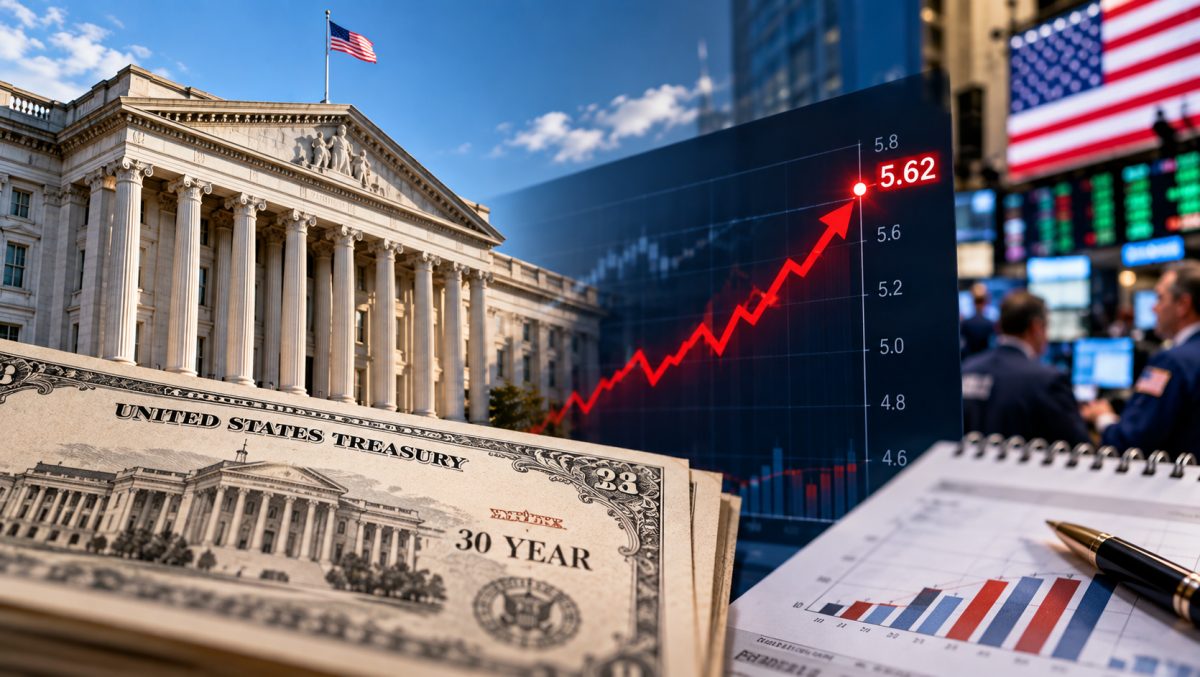

Long-term borrowing costs surged to levels unseen in decades, overshadowing tech-sector optimism as consumer confidence and job openings both weakened sharply.
U.S. stocks closed modestly lower on Tuesday, September 29, 2026, in New York as a renewed climb in long-term Treasury yields overwhelmed gains in technology shares, according to Reuters. The S&P 500 finished roughly flat to slightly negative, while the Dow Jones Industrial Average and Nasdaq Composite posted limited declines, as investors weighed weak consumer-confidence and job-openings reports against mixed signals from Federal Reserve officials about the future pace of interest-rate increases.
Wall Street Slides as Trump Rejects Iran Deal, Oil Spikes and Nvidia Bets Big on Itself
Treasury Yields Surge to Multi-Decade Extremes
The most consequential market move on Tuesday unfolded in the bond market rather than in equities. The yield on the 30-year U.S. Treasury bond climbed to 5.6206%, its highest level since June 2002, according to Reuters. The benchmark 10-year Treasury yield rose to 5.293%, a level not seen since June 2007. A separate late-session market update placed the 30-year yield near 5.61% and the 10-year near 5.285%, indicating yields held close to their intraday peaks even after a modest retreat.
Higher yields make fixed-income securities more attractive relative to stocks and raise the discount rate applied to future corporate earnings, a dynamic that weighs most heavily on technology and other growth-oriented companies whose valuations rest on profits expected years into the future. Tuesday's session illustrated that pressure directly, even as enthusiasm surrounding artificial-intelligence stocks helped prevent a steeper technology-sector selloff.
Not every part of the yield curve moved in the same direction. The two-year Treasury yield, which is highly sensitive to near-term Federal Reserve policy expectations, fell roughly 3.51 basis points to 4.889% after touching 4.9596% earlier in the session, its highest point since May 2024, according to Investing.com. The divergence between short- and long-term yields underscored investor uncertainty over whether the Fed's next moves would tame inflation expectations at the long end of the curve.
Wall Street Futures Dip After Record-Chasing Rally :Why Inflation Data Now Holds the Cards
Consumer Confidence Collapses to a 12-Year Low
The Conference Board reported that its Consumer Confidence Index dropped 6.7 points in September to 81.9, its lowest reading since 2014 and a nearly 12½-year low, marking the third consecutive month of weakening sentiment. Households grew more pessimistic about both current economic conditions and their expectations for business and labor-market conditions over the following six months, the Conference Board said, as reported by Reuters and Yahoo Finance.
The Conference Board attributed the deteriorating outlook in part to concerns tied to the war involving Iran and to higher interest rates. Because consumer spending drives a large share of U.S. economic activity, a sustained erosion in confidence carries the potential to eventually curb household purchases, housing activity and business revenues, though confidence surveys do not always translate immediately into changed spending behavior.
Labor Market Shows Signs of Cooling
The Labor Department's Job Openings and Labor Turnover Survey, known as JOLTS, showed available positions fell by 256,000 to 7.079 million on the last day of August, well below the 7.225 million economists surveyed by Reuters had forecast. The reading marked a five-month low and suggested employers grew more cautious about expanding payrolls as summer ended, according to Bloomberg's Markets Wrap coverage carried by Swissinfo.
Layoffs nevertheless remained subdued, a distinction that matters for monetary policy. Fewer job vacancies can ease wage and inflation pressures, but a labor market that continues adding jobs without cooling further could give the Federal Reserve room to keep interest rates restrictive if inflation remains elevated. The combination of falling openings alongside steady layoffs points to a gradual softening rather than an abrupt downturn.
Federal Reserve Officials Send Mixed Signals
The data landed as markets reassessed the Federal Reserve's next steps following its decision earlier in September to raise the overnight benchmark rate by 25 basis points to a 3.75%-4.00% target range, its first increase since 2023, according to Reuters. Investors have been trying to determine whether that hike represents the start of a renewed tightening cycle or a limited, targeted response to inflation and financial pressures.
New York Fed President John Williams helped calm some rate-hike anxiety, telling reporters the central bank had time to evaluate incoming data before deciding on further increases, Reuters reported. His remarks contributed to the decline in two-year yields. Odds of an October rate hike stood at 70%, with 58% odds of an additional increase in December, according to the CME FedWatch Tool cited by Charles Schwab. Other Fed officials continued to stress the risk of entrenched inflation and left the door open to further tightening, while others urged caution given weakening labor demand and eroding consumer sentiment.
Oil Prices Ease and Tech Stocks Find Support
Crude prices retreated during the session as signs emerged of recovering exports from the Middle East, helping limit the rise in inflation-sensitive yields and easing some pressure on equities, Reuters reported. A sustained rebound in oil prices could otherwise complicate the inflation outlook and reduce the odds of future rate cuts.
Technology shares found a separate source of support from optimism surrounding a potential initial public offering by Anthropic, which lifted AI-related stocks and partially offset the drag from rising yields. Investors now await forthcoming inflation and labor-market reports, along with further Federal Reserve communication, to determine whether long-term yields continue climbing or begin to retreat from their multi-decade highs.