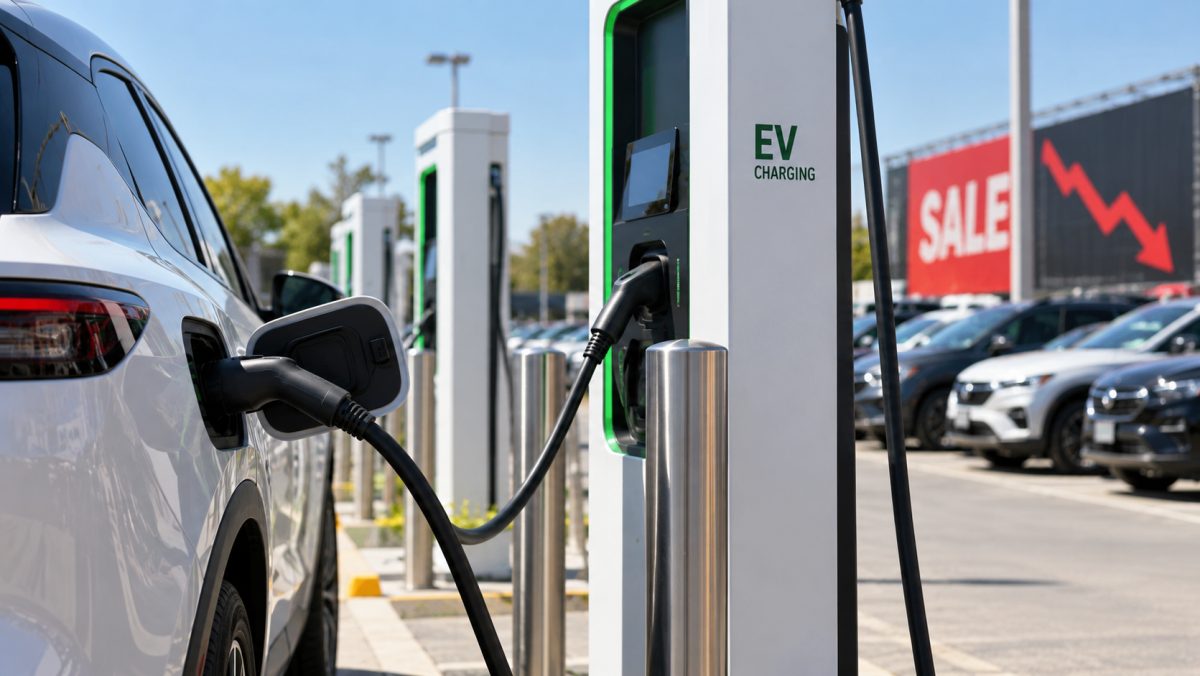

Car buyers are walking away from EVs, but the plugs they left behind are working better than ever.
U.S. electric-vehicle sales fell by about 50% year over year, the Wall Street Journal reported on October 11, 2026, yet public charging companies kept building at nearly the same pace as their record year in 2025, and the network's reliability kept climbing right alongside it.
Riyadh Airport Attack Kills 12, Will Trump Send US Troops Against Houthis Next?
U.S. EV Charging Reliability Keeps Climbing Even as Buyers Pull Back
The numbers tell a strange story. Sales of new electric vehicles cratered, but the public charging network didn't flinch. By the end of March 2026, the U.S. had nearly 245,000 public charging connectors, more than double what existed back in 2021, according to Department of Energy data cited by industry researchers. That's not a pause. That's steady, deliberate growth happening while the main product the chargers support is struggling to find buyers.
Reliability numbers back up the trend. The network's average reliability score rose from 86.8 in March 2024 to 93.4 by March 2026. Paren, a data firm that tracks fast chargers nationwide, recorded an even higher national reliability score of 93.8 in the second quarter of 2026. Most states now sit in the 90% to 95% reliability range, a notable jump from the 85% to 92% range reported just a year earlier.
Rick Ross Arrested on Felony Strangulation Charge After Monthlong Delay in Reporting Alleged Attack
Why Charging Companies Keep Building While EV Sales Fall
It sounds backwards. Why pour money into chargers when fewer people are buying the cars that use them? The answer is simple. Charging companies aren't just chasing new-car buyers. They're targeting people who already own EVs and want trips to go smoothly, the growing pool of used-EV shoppers picking up cheaper cars, and a possible rebound in new-EV demand down the road.
Fast-charging installations grew about 30% in 2025 alone, adding roughly 18,000 connectors. That expansion didn't stop when sales numbers turned ugly. Operators added another 4,382 charging ports across 806 stations in the second quarter of 2026, according to Paren's industry report. That's actually 10% fewer new ports than the same quarter in 2025, showing some pullback, but it's still a substantial build-out during a sales slump most industries would treat as a reason to freeze spending.
Drivers Are Noticing Fewer Broken Chargers and Shorter Waits
Real driver experience seems to be catching up with the statistics. J.D. Power's 2026 EVX Public Charging Study found that the rate of failed charging attempts, what the industry calls the non-charge visit rate, dropped to 12% in 2026 from 14% the year before. Satisfaction with DC fast charging jumped 12 points year over year, landing at 666 out of 1,000 on J.D. Power's scale.
Charging sessions themselves are up sharply too. Paren reported 46 million charging sessions in the second quarter of 2026, a 15% jump from the previous quarter. That growth happened even though overall network utilization barely moved, sitting at 15.76% in Q2 2026 compared to 15.64% in Q1. In plain terms, more people are charging more often, but new stations are coming online fast enough that lines and congestion haven't gotten worse.
The Money Problem Nobody Has Solved Yet
Here's the catch nobody can ignore. Building and running chargers costs real money, from land and electricity to maintenance crews who fix broken screens and cables. Low utilization, hovering around 15% to 16% for over a year now, makes it hard for operators to earn back what they spent. Average utilization actually peaked at 16.5% in the fourth quarter of 2025 and has drifted slightly lower since then.
Paren's own analysis frames this as a glass-half-full situation. Deployment is keeping pace with the number of EVs actually on the road, the company said, which is why session counts keep rising even while utilization stays flat. Usage is spread unevenly across the country too. Places like the District of Columbia, Hawaii, California, Florida, Maryland, Nevada, and Arizona show the highest charger utilization, while plenty of other regions lag behind with emptier stations and slower returns on investment.
What a Slower Car Market Means for the Charging Business Ahead
Consumer attitudes may be shifting too. A fourth annual EV Index survey from HERE and SBD found that optimism about EVs jumped from 28% in 2025 to 47% in 2026, with much of that boost tied directly to better perceptions of public charging availability. People are starting to trust that a charger will actually work when they pull up to it, which matters more than almost anything else for buyers considering their first EV.
The road ahead still depends heavily on whether new-EV sales recover. If the slump drags on, charging companies could be stuck with underused equipment and slow paybacks on a massive infrastructure bet. But if falling used-EV prices, steadier reliability, or new incentives bring buyers back, the network built during this downturn could end up as the industry's biggest advantage, a charging system that was already fixed and ready before demand caught up to it.