
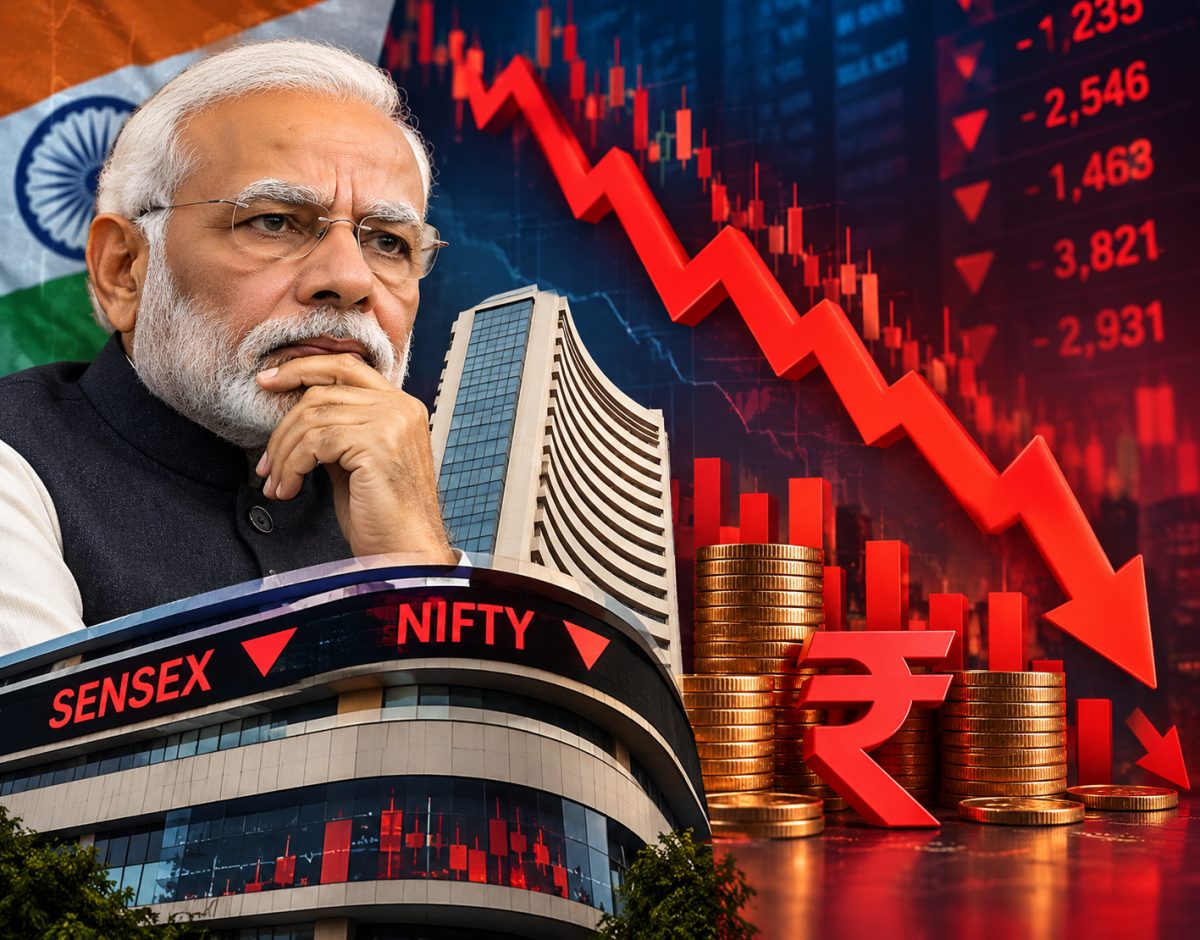

Foreign selling, surging crude prices and a looming RBI rate decision combined to drag Sensex and Nifty into their longest weekly losing run in a quarter century.
Indian equity benchmarks Sensex and Nifty extended losses for a fourth consecutive session through Thursday, October 2, 2026, erasing approximately ₹5 lakh crore from the market capitalisation of listed companies as heavy foreign institutional investor selling, rising government-bond yields, elevated crude-oil prices and a weakening rupee combined to crush risk appetite, according to The Economic Times. The Nifty 50 closed the week at 22,421.95, down 3.11%, marking its eighth consecutive weekly decline — a losing streak market observers described as the longest in roughly 25 years. The Sensex fell 2.69% over the same five sessions and touched a fresh 52-week low, while the Nifty broke key technical support levels, setting up Monday's session as the next test of investor resolve.
Why a Yale-Linked Macro Trader Says Never Short a Stock Just Because It Looks Expensive
Foreign Outflows Intensify a Four-Session Slide
The most immediate trigger behind the rout was sustained foreign portfolio investor selling. Market commentary cited in the report indicated that foreign investors offloaded approximately $1.06 billion of Indian equities on September 30 alone, and nearly $3.6 billion over the five-session period — a scale of withdrawal that amplified the broader risk-off move, particularly across large-cap and index-heavy stocks. A separate market rewind put the week's FII selling at roughly ₹35,000 crore, underscoring how persistent the outflows have become.
Higher global bond yields have made emerging-market equities comparatively less attractive by raising the discount rates used to value future corporate earnings. That dynamic has pushed overseas investors toward dollar-denominated fixed-income assets, leaving Indian benchmarks increasingly dependent on domestic liquidity to absorb the selling pressure. The Nifty's slide to a six-month low, as described in one market rewind, illustrates how thoroughly the sell-off has broadened beyond individual sectors into financials, technology and consumer-facing segments alike.
Why Sensex and Nifty's Fate This Week Hinges on Iran Talks and the Strait of Hormuz
Crude Near $108 and US Yields Above 5% Compound the Pressure
Brent crude moved toward approximately $108 a barrel amid geopolitical uncertainty, a level that carries outsized consequences for India, which imports the bulk of the crude oil it consumes. Sustained high oil prices threaten to widen the current-account deficit, inflate the import bill, weaken the rupee further and stoke inflation risks — while simultaneously pressuring corporate margins and household purchasing power through higher fuel and transport costs. Analysts treated the crude spike as both an earnings risk and a monetary-policy risk simultaneously.
Compounding that strain, the US 10-year Treasury yield moved above 5%, a threshold that has historically placed significant pressure on emerging-market assets by drawing global capital toward dollar fixed-income securities and raising the worldwide cost of capital. In India's case, the effect was compounded by currency weakness concerns and the prospect that domestic interest rates could remain restrictive for an extended period, feeding directly into expectations ahead of the Reserve Bank of India's policy meeting.
RBI Policy Decision Looms as October 7 Deadline Approaches
The Reserve Bank of India's Monetary Policy Committee was scheduled to meet from October 5 to October 7, with the policy announcement due on October 7. A Reuters poll cited in market commentary found that about 60% of economists expected a 25-basis-point repo-rate increase to 5.50%, reflecting concerns that inflation, currency pressure and imported energy costs could force a more cautious stance from the central bank. The outcome remained a forecast rather than a confirmed decision, and investors were watching not just the headline rate but the RBI's inflation assessment, liquidity guidance and forward-looking commentary.
Geojit Financial Services head of research Vinod Nair struck a measured tone on the near-term outlook, noting that "while elevated oil prices and global yields may continue to temper risk appetite in the near term, improving valuations and resilient domestic growth prospects are encouraging selective accumulation, helping the market absorb external pressures more effectively." Nair had earlier credited strong domestic liquidity with keeping the Nifty above the 23,000 mark during an earlier phase of weakness, though that cushion has since been tested by the combined force of crude prices, bond yields and relentless foreign outflows.
Earnings Season and Domestic Liquidity as Key Swing Factors
Companies were approaching the September-quarter results season, with analysts expecting second-quarter earnings to soften compared with the first quarter, which had benefited from a lagged reduction in operating costs that may not recur. Investors were bracing for early guidance from information-technology bellwether TCS and retail operator Avenue Supermarts, whose updates were expected to offer the first concrete evidence on demand trends, margin pressure and consumer resilience heading into the festive season.
Domestic mutual funds and retail investors via systematic investment plans remained the principal counterweight to foreign selling, though analysts cautioned that this buffer was increasingly strained. The report's central message was cautious, selective accumulation rather than aggressive buying or panic selling — a stance analysts tied to improving valuations after the correction, even as the external pressures driving the downturn remained unresolved. A durable recovery, they said, would likely require some combination of softer crude prices, stabilising US yields, reduced FII selling, a steadier rupee and earnings results that validate current market expectations.