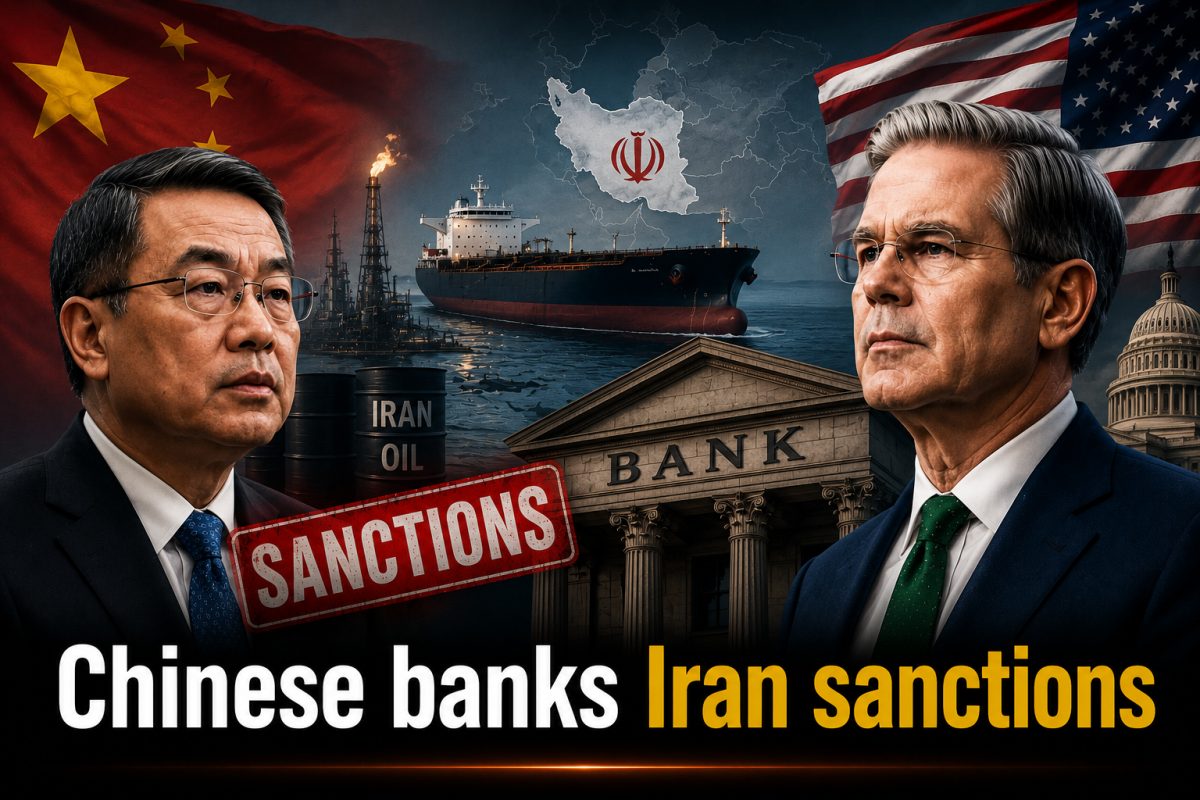

Republican lawmakers argue the Treasury Department's new Iran sanctions campaign leaves untouched the Chinese banks and refiners that keep Tehran's oil revenue flowing.
U.S. lawmakers are pressing the Treasury Department to expand its Iran sanctions campaign to directly target Chinese banks and other financial conduits that facilitate Iran's oil and petrochemical trade, arguing that the administration's newly launched sanctions push has not yet reached the most critical Chinese nodes sustaining Tehran's energy revenue. The pressure follows Treasury Secretary Scott Bessent's announcement on Monday, August 24, 2026, of what he dubbed "Operation Economic Outcast," an "economic D-Day" against Iran that imposed sanctions on 60 Iran-linked individuals, entities and vessels but stopped short of penalizing major Chinese financial institutions.
The sanctions rollout, confirmed by Treasury and reported by Politico, Reuters, Bloomberg and NPR, targeted a global network of brokers, companies and shadow fleet vessels operating across the United Arab Emirates, Hong Kong, China, Singapore, Switzerland and Europe that transport Iranian oil and channel revenue to Iran's Islamic Revolutionary Guard Corps. Despite that broad geographic reach, Treasury did not sanction any large Chinese banks and did not escalate action against China's small private "teapot" refineries, which handle much of the Iranian crude that reaches international markets.
Bessent Unveils Sweeping New Iran Sanctions But Delays Toughest Banking Blow
Republicans Demand Treasury Escalate Against Chinese Financial Institutions
Congressional Republicans have been the most vocal in pushing Treasury to move beyond traders and shippers to the banks that clear payments tied to Iranian oil. Sen. Jim Risch of Idaho, ranking member of the Senate Foreign Relations Committee, led a letter with Sens. Marco Rubio, John Barrasso, Lindsey Graham, Rick Scott, Jerry Moran, James Lankford and Bill Hagerty urging Treasury and State to enforce existing sanctions authority, including Executive Order 13846, and to expand designations to those who store, ship, refine or otherwise deal in Iranian-origin oil and petrochemicals, particularly entities based in the People's Republic of China.
Separately, Rep. John Moolenaar of Michigan and all 11 Republican members of the House Select Committee on the Chinese Communist Party sent a letter to Treasury calling on the Office of Foreign Assets Control and the Financial Crimes Enforcement Network to investigate six major Chinese companies — Norinco, AVIC, COSCO, CNOOC, CRRC and Sinopec — for potential sanctions violations tied to support for Iran's military and energy sectors. Together, these efforts reflect a sustained congressional argument that Treasury already possesses the legal authority to act against Chinese banks and refiners but has so far declined to use it fully.
Bessent Signals Willingness but Has Not Pulled the Trigger
Bessent has repeatedly said Chinese banks are not exempt from U.S. sanctions authority, even as Treasury has avoided naming any specific institution in its latest package. Asked directly about Chinese banks during Monday's rollout, Bessent said, "We want to make clear here today that no one is above the reach of U.S. sanctions." He added that any entity facilitating "money laundering or sanctions evasion on behalf of Iran risks being cut off from the U.S. financial system."
In an earlier briefing in April 2026, Bessent disclosed that Treasury had already sent warning letters to two Chinese banks regarding the risk of secondary sanctions if they were found supporting transactions tied to Iran. He has also said that banks which "facilitate transactions and are part of the ecosystem that turns Iranian oil into money, into repression, they will be targeted." That same month, Treasury sanctioned 35 entities and individuals for roles in Iran's shadow banking sector and threatened sanctions against banks doing business with Chinese teapot refineries that pay fees for oil shipments across the Strait of Hormuz.
China Remains the Largest Buyer of Iranian Crude
China's role in Iran's oil trade is central to the lawmakers' argument. Reporting cited in Politico's coverage describes China as the largest buyer of Iranian oil, with some analyses putting its share of Iran's crude exports as high as 90 percent. Chinese teapot refineries and other PRC entities are described as handling the bulk of that trade, making Chinese financial institutions the key link between Iranian oil sales and usable revenue for Tehran.
Lawmakers pressing Treasury argue that without directly targeting Chinese banks and refiners, Iran will continue earning substantial revenue regardless of how many individual brokers, vessels or shell companies are sanctioned. They point to Treasury's own authority under Executive Order 13846 and related statutes mandating sanctions against foreign financial institutions that knowingly facilitate significant transactions for Iran's energy sector as evidence that the tools already exist.
Beijing Rejects U.S. Pressure Campaign
China has publicly pushed back on the broader sanctions effort. Chinese Foreign Ministry spokesperson Lin Jian said Tuesday that Beijing would not submit to U.S. "economic warfare" and would not cut off economic ties with Iran, citing concerns about risks to international stability. That statement signals that any direct U.S. move against Chinese banks could trigger a significant diplomatic confrontation between Washington and Beijing.
The administration appears to be calibrating its approach, escalating sanctions in stages while avoiding an immediate full-scale confrontation with China or disruption to global oil markets. Whether that caution will give way to direct action against Chinese banks remains an open question, with lawmakers continuing to press Treasury to close what they view as the central gap in the Iran sanctions campaign.