
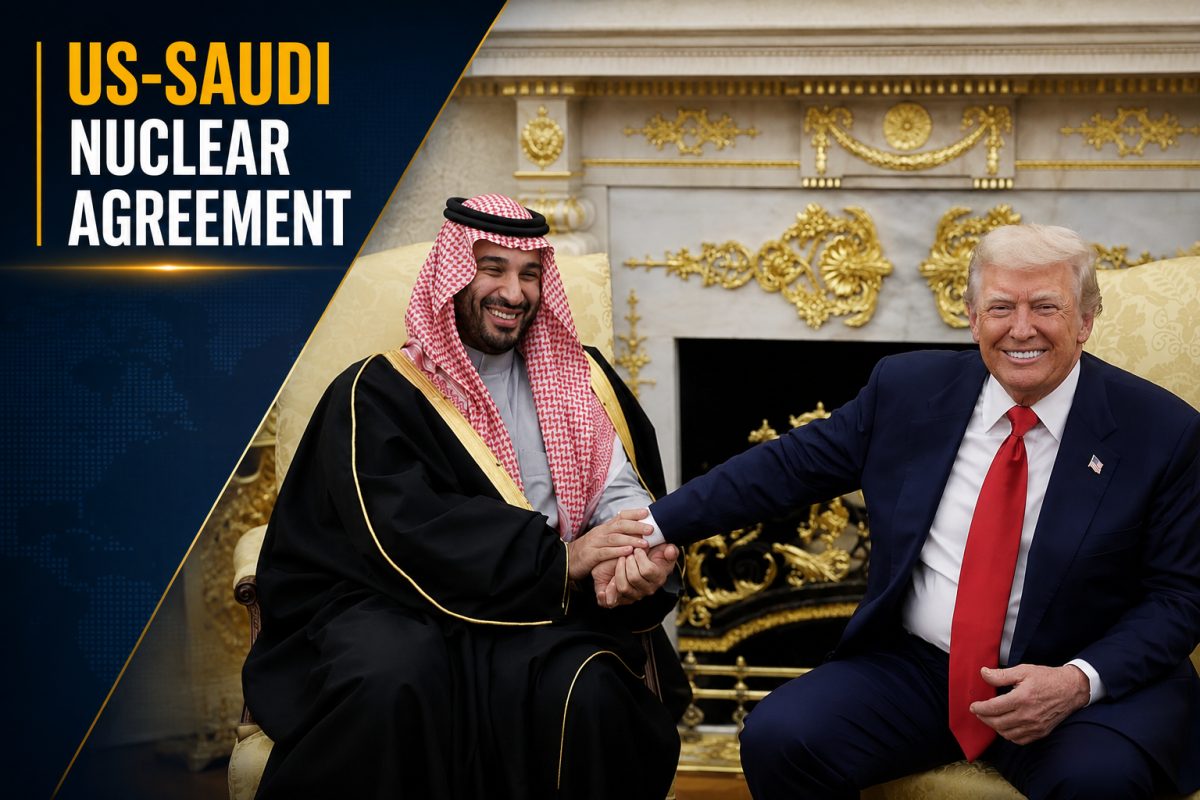

Formal congressional submission starts statutory 90-day clock on deal allowing Saudi civilian nuclear program and potential uranium enrichment.
President Donald Trump has formally sent a nuclear cooperation agreement with Saudi Arabia to Congress for review, the Wall Street Journal reported August 25, 2026, advancing a deal that would let the kingdom develop a U.S.-backed civilian nuclear program and potentially enrich uranium on its own soil. The transmittal in Washington triggers the statutory review process under the U.S. Atomic Energy Act, giving lawmakers 90 session days to act before the agreement can automatically take effect. The move follows Trump's July 2026 approval of the deal and the earlier signing of the underlying Section 123 Agreement by Energy Secretary Chris Wright and Saudi Energy Minister Prince Abdulaziz bin Salman.
The agreement, officially titled the Saudi Arabia–United States Agreement for Cooperation on the Peaceful Uses of Nuclear Energy, is described in prior reporting as a 30-year pact worth tens of billions of dollars. It would grant U.S. companies priority access to Saudi nuclear projects, including reactor construction and fuel supply, while opening a pathway for domestic uranium enrichment in Saudi Arabia following a joint U.S.-Saudi study.
Congress Now Holds the Deal's Fate
With the agreement and a required Nonproliferation Assessment now in lawmakers' hands, the 90-session-day countdown has formally begun. Under the Atomic Energy Act, the deal will automatically enter into force if Congress takes no action within that window. Blocking it would require both chambers to pass a joint resolution of disapproval, which would then need a two-thirds majority in each chamber to survive an expected presidential veto.
That procedural bar makes outright rejection difficult, but it does not eliminate the possibility of intense congressional pushback. Relevant committees overseeing foreign affairs, energy and armed services are expected to hold hearings with administration officials from the Department of Energy, State Department and National Security Council, alongside outside nonproliferation experts.
Congressional critics have already signaled where the fight will center. Rep. John Garamendi, Sen. Ed Markey, Sen. Jeff Merkley and Rep. Don Beyer, who co-chair the bicameral Nuclear Weapons and Arms Control Working Group, published an op-ed warning that the deal would allow Saudi Arabia to produce weapons-grade uranium and plutonium without requiring the International Atomic Energy Agency's Additional Protocol, the strongest available international inspection standard.
The Safeguards Gap at the Center of the Debate
Multiple sources confirm the agreement does not require Saudi Arabia to adopt the IAEA's Additional Protocol, a verification standard the United States has insisted on in other 123 Agreements, including its pact with the United Arab Emirates. The Department of Energy has referenced an accompanying bilateral safeguards agreement, but independent experts say the details remain unclear.
The Arms Control Association, in an August 7 analysis, noted that the deal appeared to depart from the so-called "gold standard," under which partner nations formally renounce enrichment and reprocessing. Saudi Arabia reportedly refused to accept that stricter condition, a sticking point that shaped the final terms Trump has now sent to lawmakers.
Saudi officials have long framed their nuclear ambitions as a matter of energy diversification, aiming to free up oil reserves for export by developing domestic nuclear power capacity. But Saudi leaders have also stated that the kingdom would pursue nuclear weapons if Iran obtained them, a comment that has amplified proliferation concerns among lawmakers and arms-control analysts reviewing the current deal.
Trump's Unresolved Israel Condition
Despite formally submitting the agreement, Trump has not withdrawn a condition he has publicly attached to the deal: that Saudi Arabia move toward diplomatic recognition of Israel or join the Abraham Accords. Reuters reported in July that Trump said he would not proceed with the nuclear deal unless Saudi Arabia took that step, framing the agreement as leverage in broader Middle East diplomacy.
The WSJ's latest reporting indicates this condition remains in place even as the formal congressional review begins, according to a source within the administration. There is no public indication that the text submitted to Congress contains an explicit clause tying implementation to Israeli recognition, suggesting the requirement functions as a political commitment from Trump rather than a binding legal term within the 123 Agreement itself.
Competing Pressures From Moscow and Beijing
Supporters of the agreement, including elements of the U.S. nuclear industry, argue that a formal 123 Agreement gives Washington far greater oversight than allowing Saudi Arabia to turn to Russia or China for nuclear technology. Analysts cited in earlier coverage note that both countries have shown willingness to offer nuclear cooperation with fewer political conditions attached.
That competitive dynamic has shaped the administration's argument that the deal, even without the Additional Protocol, keeps Saudi Arabia's nuclear ambitions anchored to U.S. standards and commercial interests. Whether Congress accepts that rationale, or moves to tighten the agreement's safeguards during the 90-day review, will determine whether the pact becomes a lasting fixture of U.S.-Saudi relations or a flashpoint in the ongoing nonproliferation debate.