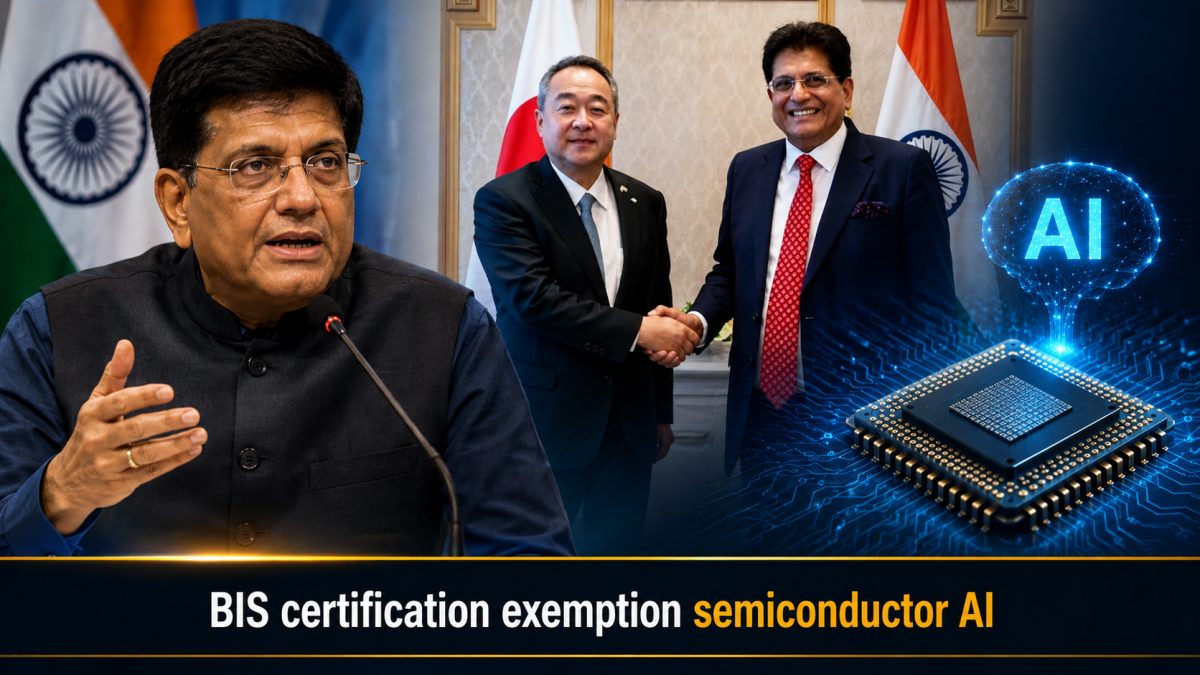

Commerce minister pledges regulatory relief and tailored infrastructure to attract Japanese chip and AI investment into India.
Commerce and Industry Minister Piyush Goyal said on 25 August 2026 that the Bureau of Indian Standards (BIS) and the commerce ministry will jointly develop a framework to ease or exempt mandatory BIS certification requirements for high-tech manufacturers, including semiconductor and artificial intelligence firms. Goyal made the announcement while speaking at a roundtable with Japanese semiconductor and AI companies in Tokyo, where he also addressed concerns over Special Economic Zone notifications and offered tailored social infrastructure for Japanese investors and their expatriate employees.
The minister framed the proposed changes as part of a broader push to position India as a global hub for electronics and semiconductor manufacturing, tying the reforms directly to the government's Make in India programme. He said the framework is intended to reduce regulatory delays that companies face when importing specialised machinery, equipment and components needed for advanced manufacturing.
Details Of The Proposed BIS Exemption Framework
Goyal indicated that the exemption mechanism now being designed could take several forms rather than a single blanket relaxation. He described the possibility of company-level exemptions granted to specific firms based on their profile, industry-level exemptions applying broadly to sectors such as semiconductors or AI hardware, product-level exemptions for particular machines or components, and project-level or bulk exemptions covering large-scale imports tied to factory setup or expansion.
He was quoted saying the government would work to find a solution through bulk exemption, or product or project based exemption, or company based exemption, with the underlying goal of ensuring timely supply of products, goods and services to support high-tech operations in India. Goyal said he had already instructed BIS and the commerce ministry to begin work on the framework and would continue developing it upon his return to India.
The rationale behind the initiative stems from complaints raised by Japanese companies about delays and procedural complexity linked to mandatory BIS certification for specialised imported equipment. High-tech manufacturing frequently relies on customised or low-volume machinery that does not fit neatly into existing certification categories, and Goyal's remarks suggest an acknowledgment that the current regime can become a bottleneck for cutting-edge manufacturing investment.
SEZ Notification Concerns Raised By Japanese Firms
Beyond BIS certification, Goyal addressed concerns Japanese companies raised regarding India's Special Economic Zone notifications. He said clarifications flagged by some players on SEZ rules would also be looked at, signalling that the government intends to review and clarify aspects of the SEZ regulatory framework that have created uncertainty for foreign investors.
No detailed text of specific amendments or a timeline for SEZ clarifications has been published. The commitment, as described, is limited to a review and clarification process rather than an announced change to existing SEZ notifications.
Red Carpet Treatment And Social Infrastructure For Japanese Investors
Goyal told the Japanese companies present that India was prepared to roll out red carpet treatment, including the creation of social infrastructure tailored to Japanese expatriate employees and their families. He referenced manufacturing hubs such as Dholera as locations where the government would work to build amenities that Japanese professionals are accustomed to, including schools and golf courses.
The offer is presented as part of a broader effort to deepen the India-Japan economic relationship. Official figures cited during the discussion note that more than 1,400 Japanese companies currently operate in India, including well-known names such as Suzuki, Toyota and Honda in mobility, Sony in electronics, and Hitachi and Mitsubishi in engineering. India and Japan had earlier signed a memorandum of understanding on semiconductor supply chains aimed at diversifying production and reducing concentration risks.
Talent Pipeline And Broader Semiconductor Push
Goyal linked the regulatory measures to India's ongoing effort to build a domestic talent base for chip design and advanced manufacturing. He cited figures showing that 68,000 students have been trained at various levels in chip design across 315 universities in India, describing this as complementary to the regulatory easing and infrastructure commitments being discussed with Japanese investors.
Taken together, the BIS exemption framework, the promised review of SEZ notifications, and the offer of tailored social infrastructure represent a coordinated set of measures aimed at making India more attractive for semiconductor and AI investment. However, the specific regulatory instruments, covered categories and implementation timelines for these measures remain under development and have not yet been finalised or published in detail.