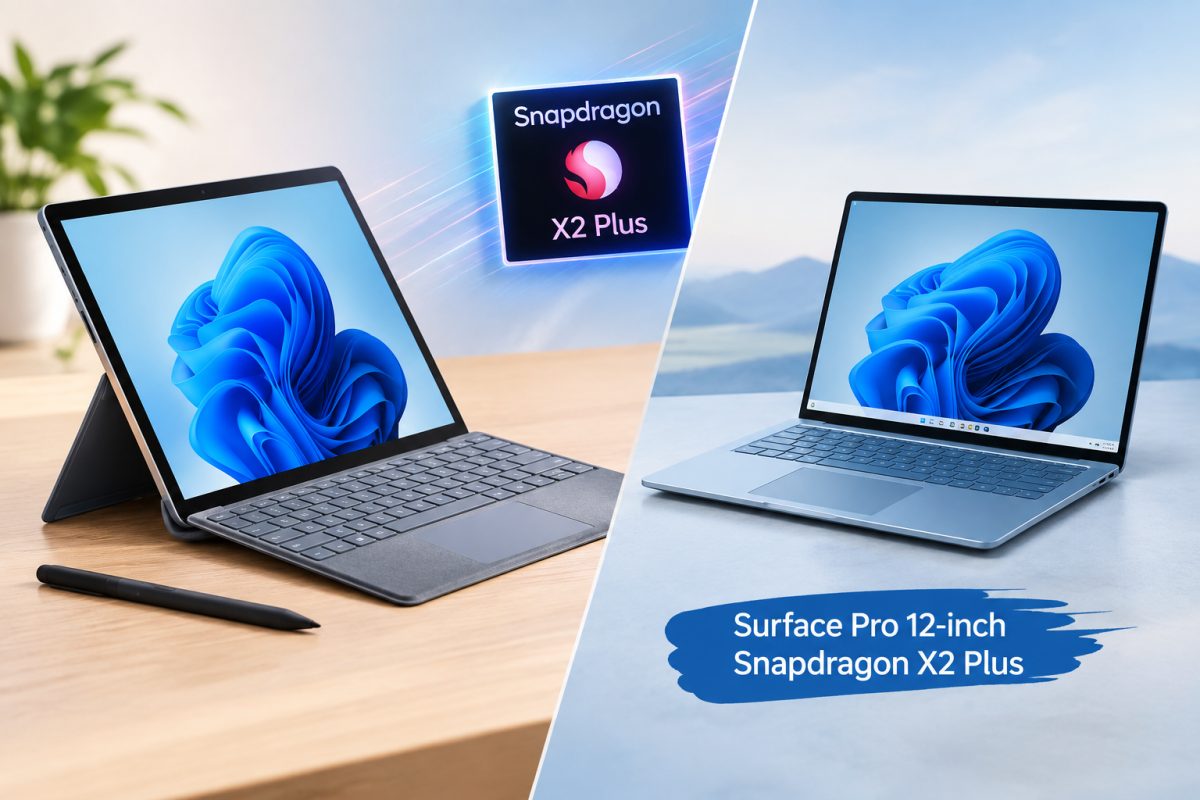

Microsoft's compact Surface Pro and Surface Laptop gain faster Qualcomm silicon, doubled minimum memory, and brighter screens, but shoppers will pay hundreds more than last year's models.
Microsoft announced on September 23, 2026, at Qualcomm's Snapdragon Summit that it is refreshing its smallest Surface computers — the 12-inch Surface Pro and 13-inch Surface Laptop — with Qualcomm's six-core Snapdragon X2 Plus processor. The devices are scheduled to launch in select markets on October 13, 2026, with US starting prices of $1,149.99 for the Surface Pro and $1,199.99 for the Surface Laptop, according to Microsoft's official announcement and multiple published reports.
Apple's iOS 27 iPhone Handoff Lets One Number Span Two Devices
Why Microsoft Is Revamping Its Smallest Surfaces
The refresh targets a widely noted weakness in the original compact lineup, introduced in May 2025: slower Qualcomm processors paired with entry-level 8GB memory configurations that limited multitasking and constrained the devices' appeal as Copilot+ PCs. Microsoft's blog post describes the new machines as delivering "greater performance that travels light," built on the Snapdragon X2 Plus platform.
The company says the new generation offers up to 18% more efficient battery performance, more than 60% faster graphics, and up to 95% faster local AI inference on the neural processing unit. Some outlets, citing Microsoft's own comparisons, report Office productivity gains of roughly 17% to 18% over the prior generation. These figures come exclusively from Microsoft's internal testing; the company has not disclosed which baseline configurations were used or how the improvements hold up under sustained workloads, meaning independent verification remains outstanding.
New RatHat Android Malware Uses AI to Hijack Phones — Even Uninstalling It Isn't Enough
Surface Pro: Same Screen Size, Sharper Specs
The refreshed Surface Pro retains its 12-inch, 3:2 PixelSense LCD touchscreen with a 2,196-by-1,464 resolution, 220 pixels per inch, a dynamic refresh rate up to 90Hz, and typical SDR brightness up to 500 nits — a display Microsoft describes as 25% brighter than its predecessor. Power comes from the six-core Snapdragon X2 Plus X2P-42-100, paired with Qualcomm's Hexagon NPU rated at 80 trillion operations per second and an Adreno GPU.
Buyers can choose 16GB or 24GB of LPDDR5x memory with 256GB or 512GB of storage. Critically, the previous 8GB option has been eliminated entirely, raising the effective entry-level specification but also pushing up the starting price. Reported battery figures include up to 15.5 hours of local video playback and up to 13 hours of active web use from a 38Wh battery. The tablet will ship in Platinum, Violet, and a new Black finish, and Microsoft is also preparing a 5G version, calling cellular connectivity "one of the most requested additions" — though pricing, carrier details, and release timing for that variant have not been disclosed.
Surface Laptop: Longer Battery Life, Modest Price Increase
The 13-inch Surface Laptop receives the identical Snapdragon X2 Plus platform and memory overhaul, retaining its 3:2 PixelSense touchscreen, full-size backlit keyboard, precision touchpad, and aluminum chassis. Its display specifications are more modest than the Pro's — 1,920 by 1,280 resolution at 178 pixels per inch with a 60Hz refresh rate and up to 500 nits brightness — but its battery claims are considerably stronger, with Microsoft citing up to 22.5 hours of local video playback or 18 hours of active web browsing.
Like the Surface Pro, the laptop drops its 8GB baseline in favor of 16GB or 24GB configurations with 256GB or 512GB storage. Its $1,199.99 starting price represents roughly a $50 increase over the prior generation's reported entry point, a comparatively smaller jump than the Surface Pro's price hike. The synchronized refresh brings both compact devices into closer technical alignment with Microsoft's larger Surface Pro and Surface Laptop models, which received Snapdragon X2-series upgrades months earlier.
The Price Trade-Off Behind the Performance Gains
The most consequential shift in this announcement may not be the chip itself but the cost of entry. The original Surface Pro 12-inch launched in May 2025 at $799, and the Surface Laptop 13-inch at $899, both becoming available in select markets on May 20, 2025. The new starting prices — $1,149.99 and $1,199.99 — represent increases of roughly 44% and 33%, respectively, though the comparison is not strictly apples-to-apples since the new baseline doubles minimum memory from 8GB to 16GB.
Microsoft's available announcement material does not indicate whether any lower-memory, lower-price configuration will persist alongside the new lineup. European retail listings, according to a report citing leaked pricing from WinFuture's Roland Quandt, place French pricing for the Surface Pro at €1,259, suggesting the higher cost structure extends beyond the US market, though Microsoft has not confirmed those figures.
What Remains Unconfirmed Ahead of the October Launch
Several details remain unresolved as the October 13 launch approaches. Microsoft has not published a complete country-by-country rollout schedule, nor has it detailed accessory pricing — a significant gap given that Surface Pro buyers typically need a separate detachable keyboard to use the device as a laptop replacement. The new Surface Mouse with integrated haptic feedback and a customizable action button, introduced alongside the computers, also lacks confirmed pricing or availability dates.
Microsoft's performance claims around battery efficiency, graphics, and AI inference speed are based on company-supplied testing rather than independent benchmarks. Analysts and reviewers are expected to conduct real-world assessments of battery longevity, thermal performance, and Windows-on-Arm application compatibility once retail units become available, which will determine whether the Snapdragon X2 Plus upgrade justifies the substantially higher entry prices for consumers weighing the compact Surface line against competing ultraportables.