
Record diesel prices and midterm pressure push Trump toward an export ban his own cabinet has not agreed on.
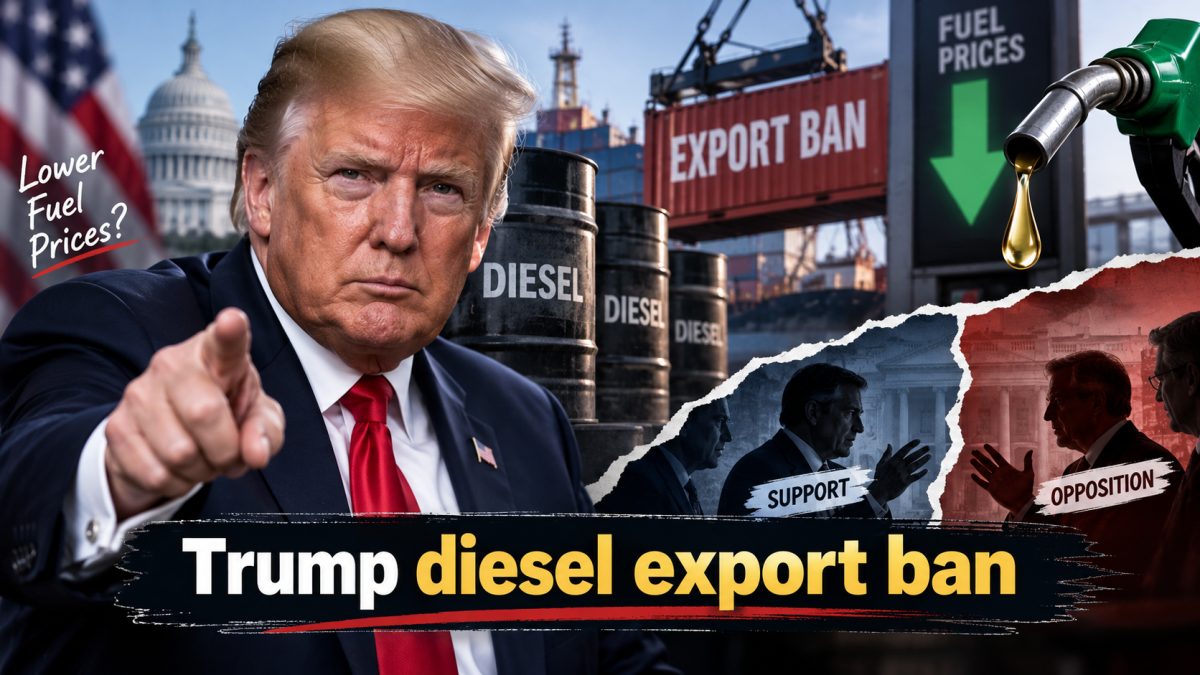
President Donald Trump said on Tuesday, September 22, 2026, in New York while attending the United Nations General Assembly that he supports a temporary ban on U.S. diesel exports, aligning himself with Republican lawmakers seeking to reduce sharply higher domestic fuel prices ahead of meetings with Ukrainian President Volodymyr Zelenskyy. "I've called for that, too. I've said, 'Let's not send out the diesel.' We make a lot of diesel," Trump told reporters, according to multiple accounts of the exchange.
Nifty Tests 23,000 Support Zone As Corrective Phase Continues, ET Reports
An Endorsement Without a Policy
Trump's remarks marked political backing for an idea the administration had not formally adopted. Treasury Secretary Scott Bessent said officials were examining "whether it's feasible in terms of the overall refining capacity and whether a full or partial ban would work," leaving open the possibility of a narrower measure targeting specific volumes, destinations or a fixed time window rather than a blanket prohibition.
No executive order, agency directive or implementation date accompanied Trump's comments. He said only that the administration would decide "fast, one way or the other." Notably, Trump claimed he had previously called for the policy "within my people," a statement contemporaneous reporting indicates was not accurate, as he had not made a public call for a diesel-export ban before that day.
Dow Jones Falls 373 Points On Trump Iran Warning As SpaceX, Tesla Rally
Record Prices and a Widening Political Push
The proposal surfaced amid a rapid spike in diesel prices tied largely to disruption from the war in Iran and the broader Middle East conflict. Reported figures varied: one account put diesel at a record $6.29 per gallon, roughly 22% above year-ago levels, while another cited $6.51 per gallon on Monday, September 21, a level Agriculture Secretary Brooke Rollins called "a real concern." The discrepancy likely stems from different price benchmarks or reporting timeframes rather than a single verified figure.
Senate Majority Leader John Thune had already signaled openness to restricting diesel shipments before Trump's remarks, telling reporters after September 15, "If the United States has the supply and is exporting it, that might be one way of getting at it." Republican lawmakers from farm and energy-producing states argued that curbing exports would boost domestic supply and ease costs for truckers, farmers and businesses ahead of the 2026 midterm elections, turning an energy question into an affordability campaign issue.
Cabinet Split Exposes the Policy's Risks
Behind Trump's public support lies visible disagreement among his own officials. A White House official said as recently as September 21 that the administration was "not considering an export ban or export restrictions at this time," even as Rollins said Trump had personally called her that Monday and that Energy Secretary Chris Wright, Interior Secretary Doug Burgum and other officials had been working through the weekend on potential actions, with an announcement expected "very soon."
Burgum voiced clear skepticism, saying the administration would only pursue a ban if it believed the move would lower prices, adding flatly, "That's not the case." Wright reportedly warned that restricting diesel exports could trigger "more expensive gasoline right away," since refiners might be forced to cut overall production instead of simply redirecting diesel toward domestic buyers.
That warning points to a structural constraint at the heart of the debate: U.S. refineries produce diesel, gasoline and jet fuel simultaneously, and a facility cannot easily boost diesel output alone. If domestic storage, transport or refinery configurations cannot absorb added diesel production, a ban could reduce refinery utilization altogether, tightening gasoline supplies even as diesel becomes more available. Trump himself acknowledged this interdependence, saying the change ""could have a little bit of effect on regular automobile gasoline," because fuel production operates as "a sort of a flow, it's a balance."
Global Trade Stakes and the Ag-Versus-Oil Divide
The United States is a significant diesel supplier to overseas markets, particularly Europe and other regions dependent on imported refined products. A full export ban could pull American cargoes from international trade, tightening supplies abroad and potentially raising foreign diesel prices, while reshaping shipping patterns, refinery economics and inventory levels. None of the reviewed reporting identified a completed administration analysis quantifying these international spillover effects.
The proposal has also sharpened a divide between agricultural and industrial interests and the refining and oil sectors. Farmers and truckers stand to benefit from lower diesel costs, while refiners could face reduced margins or forced production cuts under export limits. Consumers face a mixed outlook: cheaper diesel could ease transportation and farming costs, but any resulting rise in gasoline prices would hit motorists directly and could blunt the policy's intended relief.
What Comes Next
The path forward is administrative rather than legislative. The administration is expected to weigh a full ban, a narrower restriction, or no new controls after reviewing refining capacity and market conditions, with Bessent's Treasury Department examining feasibility alongside Energy and Interior officials. Trump's endorsement has intensified pressure for a swift decision, but as of September 22, no executive order, regulatory filing, scheduled vote or effective date had been confirmed.
Until such a measure is formally issued, the diesel export ban remains a proposal under internal review rather than an operative change to U.S. fuel-export law, leaving farmers, truckers, refiners and international buyers watching for the administration's next move.