
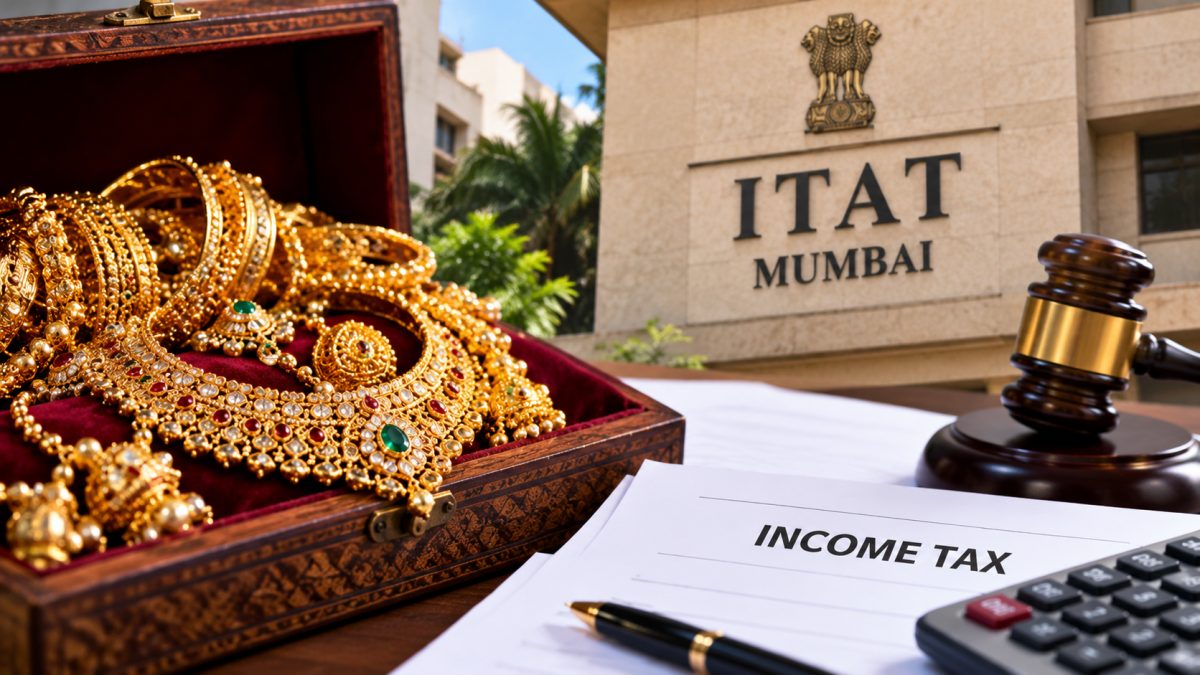

ITAT Mumbai delivers split verdict, clearing ancestral jewellery from tax scrutiny while rejecting a duplicate brokerage claim routed through a family HUF.
The Mumbai bench of the Income Tax Appellate Tribunal has partly allowed an appeal by Anjani Ashok Parikh, a taxpayer from Vile Parle West, deleting a ₹67,39,949 addition made on jewellery declared in her income-tax return while separately upholding a ₹12 lakh disallowance linked to brokerage paid to a Hindu Undivided Family. The order, passed on September 1, 2026, resolves a dispute that began when Parikh's income crossed the threshold requiring her to file Schedule AL, the asset-and-liability disclosure schedule, for the first time.
India's GST Overhaul Moves Beyond Tax Rates, Targeting Refunds, Registration and Disputes
How a Routine Disclosure Triggered a Tax Notice
Parikh's Schedule AL filing showed jewellery valued at ₹67,39,949. Under Indian tax rules, individuals and HUFs with total income exceeding ₹50 lakh must mandatorily disclose assets including immovable property, jewellery, vehicles, shares and securities in this schedule, according to the Income Tax Department's own guidance and ClearTax's explainer on Schedule AL applicability. Because this was Parikh's first such disclosure, the entry drew departmental attention.
The assessing officer's suspicion was rooted in an evidentiary gap: departmental records showed no recent wealth-tax disclosure corresponding to the jewellery, and Parikh had not continued filing wealth-tax returns after assessment year 1997-98. From this absence, the department inferred that the jewellery might have been sold, converted, or otherwise disposed of, and that its reappearance in a later return required a fresh explanation of source and ownership.
Senior Citizen Wrongly Taxed ₹25 Lakh on Tax Free Bonds: ITAT Delhi Orders Refund
Section 69A and the Department's Unexplained-Asset Theory
Acting on that inference, the assessing officer made an addition under Section 69A of the Income Tax Act, 1961, a provision that applies when a taxpayer is found to own money, bullion, jewellery or other valuable articles without a satisfactory explanation. The department effectively treated the jewellery as an unexplained asset rather than accepting Parikh's position that it constituted inherited, ancestral family property passed down over decades.
Parikh contested this characterization, arguing that the discontinuation of wealth-tax filings was not proof of sale or disposal, and that ancestral jewellery does not need to be reported annually once wealth-tax requirements change or lapse. The case echoes a broader principle noted in tax literature, including commentary from itatonline.org on jewellery found during search proceedings, which holds that taxpayers claiming ancestral or inherited jewellery must substantiate possession through documentation such as wills or family records, though the standard of proof required varies by case.
The Tribunal's Reasoning and What It Means for Taxpayers
The ITAT's central finding was unambiguous: non-filing of wealth-tax returns after assessment year 1997-98 could not, by itself, establish that the jewellery had been sold. The tribunal held that the department's theory rested on assumption rather than direct evidence of a sale, transfer, or acquisition from undisclosed income, and on that basis deleted the entire ₹67.40 lakh Section 69A addition.
The ruling does not grant blanket immunity to inherited jewellery claims. It draws a narrower line: when tax authorities rely on an inference of sale or unexplained ownership, that inference must be tied to actual evidence rather than the mere absence of continued filings. A later disclosure in Schedule AL can legitimately prompt scrutiny, but scrutiny alone does not convert a disclosed asset into unexplained income without supporting proof.
The Parallel Brokerage Dispute Over an HUF Payment
The same assessment also examined ₹30 lakh in brokerage that Parikh claimed in connection with purchasing a new residential flat. The payments were split three ways: ₹12 lakh to an individual identified as Abhiraj Ajit Rao, ₹12 lakh to Ajit Rao HUF, and ₹6 lakh to another person, Anuradha P. Muranjan. The assessing officer accepted the payments to the individual and the third party but disallowed the ₹12 lakh routed to the HUF.
The tribunal's scrutiny centered on duplication. It found that the individual who served as the HUF's Karta or coparcener had already been paid ₹12 lakh in his personal capacity for the same property transaction. Parikh argued the HUF payment was genuine, backed by documentation and reflected in the HUF's own tax filings, but the ITAT was not persuaded that the HUF had rendered a distinct, separate brokerage service using its own resources or effort.
Two Standards of Proof in a Single Assessment
The tribunal's conclusion on brokerage rested on a different evidentiary logic than its finding on jewellery. Receiving money, issuing an invoice, and declaring it for tax purposes demonstrated that funds changed hands and were reported, but did not demonstrate that the HUF performed independent work, such as identifying the property, negotiating terms, or facilitating the deal, separate from the individual's efforts. Consequently, the ₹12 lakh HUF brokerage disallowance was sustained even as the jewellery addition was fully reversed.
The case offers a practical lesson for taxpayers navigating Schedule AL disclosures and transaction structuring involving family entities. Retaining historical documentation, including old wealth-tax records, valuation certificates, and family ownership history, strengthens claims over inherited assets, while payments split across related individuals and HUFs require a demonstrable, independent service trail to survive assessment. No broader market, political, or industry reaction to the ruling has been reported beyond the immediate tax relief and disallowance outcome.