
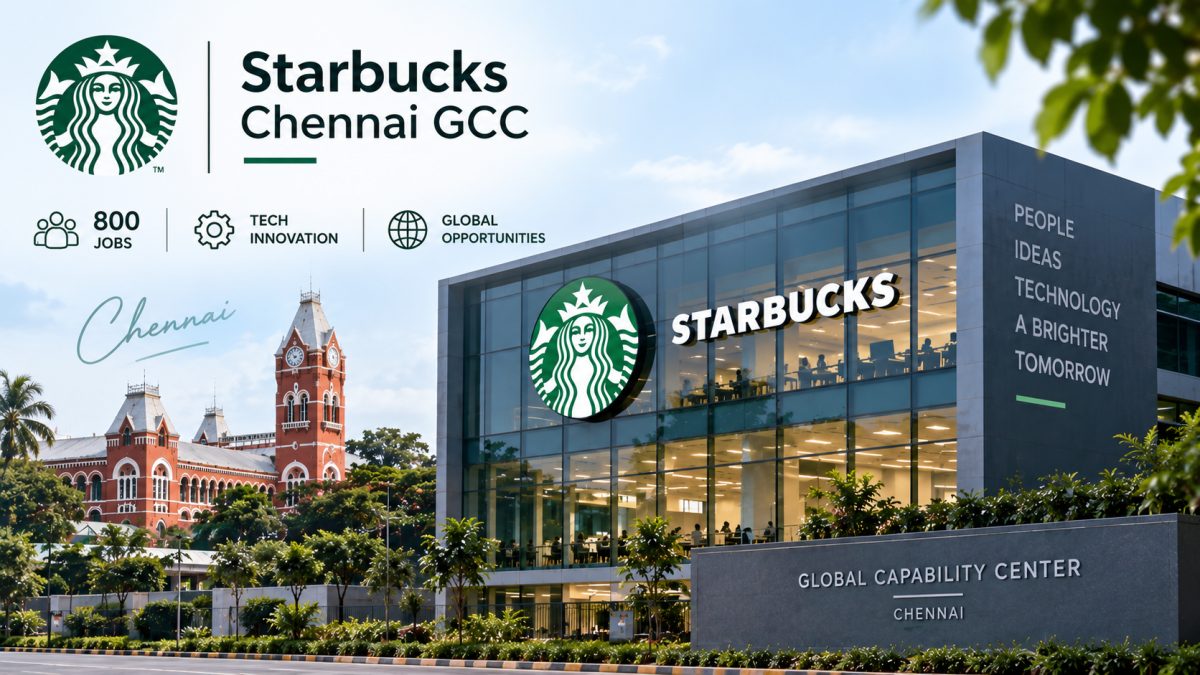

Coffee giant's Chennai technology hub, separate from its café business, signals a deeper strategic bet on India's engineering talent pool.
Starbucks Coffee Company signed a Memorandum of Understanding with the Tamil Nadu government on Monday, 21 September 2026, to establish its first Global Capability Centre (GCC) in India, a technology and corporate hub in Chennai expected to create around 800 high-value technology jobs in its first phase. The agreement was signed at the Secretariat in Chennai in the presence of Chief Minister C. Joseph Vijay, with state investment agency Guidance Tamil Nadu serving as the official counterpart.
RBI Deputy Governor Warns of Bank Technology Concentration Risks in Mumbai
Inside the Chennai Agreement
The Chennai GCC marks a distinct departure from how Starbucks has operated in India for over a decade. Since entering the country, the company has run close to 500 cafés through a retail joint venture with Tata Consumer Products, a partnership focused entirely on store operations and consumer-facing business. The new facility, according to the Tamil Nadu Industries, Investment Promotion and Commerce Department, will function as a standalone technology and corporate hub that operates independently of that retail venture, supporting Starbucks' global business, technology and operations teams, particularly those based in the United States.
Reports indicate the facility is planned for the DLF Downtown complex in Taramani, situated along Chennai's newly designated OMR GCC Corridor, a zone the state government has been actively developing to cluster global capability centres together. The timing places Starbucks alongside another recent high-profile entrant, US pharmacy chain Walgreens, which announced its own Chennai GCC plans shortly before Starbucks finalized its agreement, reinforcing the city's emerging identity as a magnet for corporate technology investment from major American firms.
India's Exports to US and China Surge Sharply in August 2026
Why Starbucks Chose Chennai Over Rivals
Starbucks Chief Technology Officer Anand Varadarajan has been quoted across multiple reports explaining the rationale behind the location decision, citing the availability of skilled talent in Chennai, comparatively lower attrition rates among technology professionals, and the city's broader engineering ecosystem and infrastructure. These factors, consistently repeated across coverage, suggest the decision was driven less by cost arbitrage and more by talent retention and technical depth, a shift that mirrors how global capability centres in India have evolved in recent years.
A state government communication, echoed in several reports, describes the Chennai facility as Starbucks' "first corporate technology hub outside the US," a characterization that signals its strategic weight within the company's broader technology organization. Varadarajan's remarks tie the Chennai investment to Starbucks' stated intent, disclosed earlier in 2026, to bring more technology work in-house that had previously been outsourced to third-party service providers, positioning Chennai as a node for direct, internally controlled software and operations delivery rather than a subcontracted back-office function.
Jobs, Numbers and What Remains Undisclosed
The headline figure across nearly all reporting is approximately 800 technology jobs expected in the first phase, described uniformly by the Tamil Nadu government and national outlets as "high-paying" or "high-value" roles for technology professionals. Some coverage suggests the number could exceed 800 as the centre scales beyond its initial phase, though official communication frames 800 as the first-phase benchmark rather than a ceiling.
Certain financial details remain unconfirmed. Moneycontrol, citing unnamed sources, reported that median salaries for roles at the hub could be around ₹35 lakh per annum, with hiring phased according to business requirements; this figure has not been confirmed by Starbucks or the Tamil Nadu government and should be treated as indicative rather than official policy. Similarly, the scale of Starbucks' capital investment in the Chennai facility has not been disclosed by either party, a gap acknowledged explicitly across Reuters, Business Standard and other outlets rather than an oversight in reporting. What has been confirmed is the operational timeline: hiring is expected to begin in Q1 2027, with the centre becoming operational during fiscal 2027 as Starbucks expands its global technology organization.
Tamil Nadu's Growing GCC Ecosystem
The Starbucks announcement lands within a broader state strategy to position Tamil Nadu, and Chennai specifically, as a leading destination for global capability centres. State data cited in local coverage indicates more than 465 GCCs already operate in Tamil Nadu, and the government has recently rolled out a formal GCC corridor and development program designed to attract further investment of this kind. Officials have framed the Starbucks deal as validation of that strategy, describing it as a "major boost" to the state's technology ecosystem and evidence that global brands are choosing Tamil Nadu over competing Indian hubs.
Industry observers tracking the sector note that GCCs globally have shifted away from low-cost back-office functions toward higher-value work spanning software development, finance, data analytics and research and development. Starbucks' Chennai centre fits this pattern, positioned not as a cost-saving outpost but as an integrated extension of the company's core technology operations. With recruitment set to begin in early 2027 and office readiness plans expected to develop over the coming months, the coming quarters will reveal how quickly Starbucks scales beyond its initial 800-role commitment and how closely the Chennai hub becomes woven into its global technology architecture.