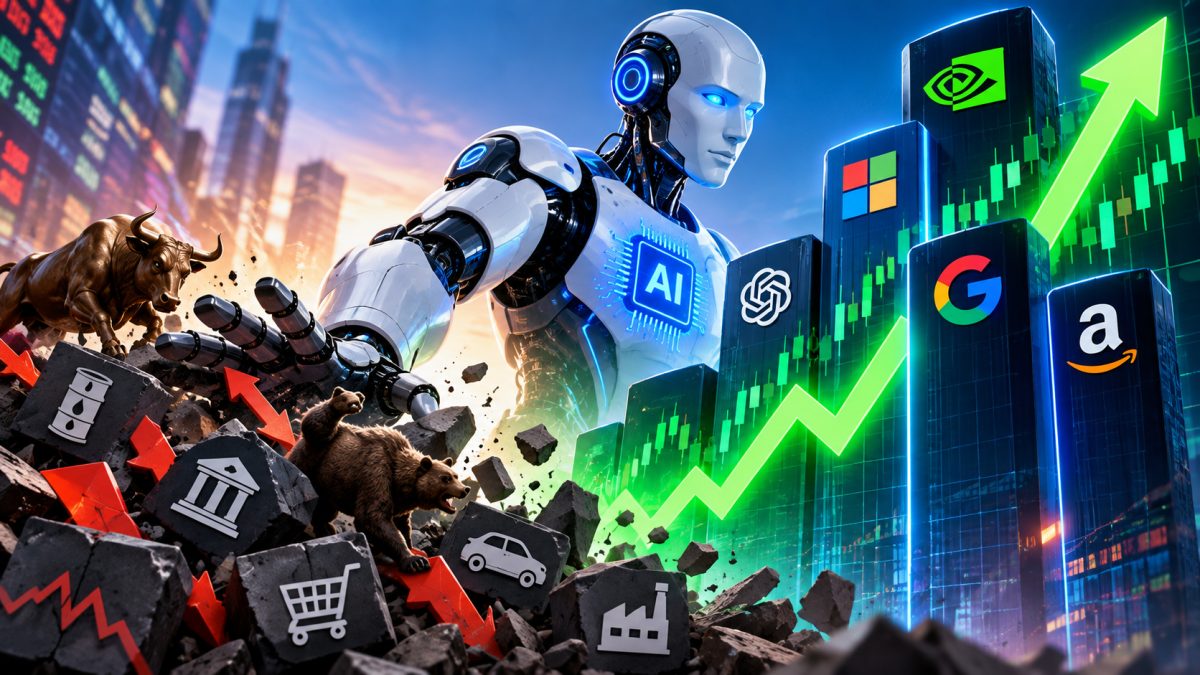

A Wall Street Journal analysis finds artificial-intelligence giants are capturing the bulk of investor capital, masking weakness across sectors squeezed by high rates and costly oil.
The Wall Street Journal reported on Oct. 2, 2026, that artificial-intelligence-linked companies have become the dominant force behind U.S. stock market gains, drawing investment away from sectors contending with elevated interest rates and rising oil prices. The Nasdaq Composite and S&P 500 were on pace for double-digit gains for a fourth consecutive year, a streak unmatched since the late 1990s, even as many non-AI companies lagged behind, according to the newspaper's finance desk.
Micron Smashes Earnings Records With AI Boom as Wall Street Remains Cautious
How a Handful of Companies Came to Define the Market
The Journal's reporting identifies Nvidia, Microsoft, Amazon, Alphabet and Meta as the chief beneficiaries of AI-driven earnings expansion, supplying the chips, cloud infrastructure and computing capacity that underpin the current technology cycle. Because these firms carry enormous weight in capitalization-weighted indexes, relatively modest percentage gains among them can move the entire S&P 500 and Nasdaq, even when hundreds of other listed companies post flat or negative returns.
A separate 2026 market analysis cited by the Economic Times found that AI-linked companies' share of S&P 500 market capitalization climbed from roughly 25% shortly after ChatGPT's November 2022 launch to about 45% by 2026. That figure reflects an external estimate rather than an official Wall Street Journal calculation, and the outcome depends heavily on how analysts define an "AI-linked" company. Still, the broader pattern—of market influence concentrating in a narrow set of firms—is corroborated across multiple Journal stories tracking the trend since early 2026.
Wall Street Roars Back as AI Fears Fade, Oil Sinks and Treasury Yields Break Below 5%
Macroeconomic Headwinds Facing the Rest of the Market
Companies outside the AI ecosystem face a dual burden, the Journal reported. Elevated interest rates raise financing costs and depress the present value investors assign to earnings expected further in the future, a particularly damaging dynamic for capital-intensive or growth-dependent businesses. Simultaneously, rising oil prices add costs for airlines, manufacturers, chemical producers and other energy-intensive industries, further widening the gap with AI-linked firms that command premium valuations.
This divergence was evident even during a summer pullback in AI shares. An Aug. 1, 2026, Journal report noted that losses in AI-related stocks were "almost completely offset by gains elsewhere," with the S&P 500 sitting only 1.6% below its record despite the AI-sector wobble—illustrating how quickly capital can rotate back toward the broader market when AI sentiment briefly sours, even as the underlying concentration concern persists.
Boom and Bust Signals Within the Same Technology Cycle
The AI theme has proven capable of both lifting and shaking the market within the same year. A Feb. 3, 2026, Journal report detailed how rapidly improving AI capabilities erased approximately $300 billion in market value in a single Tuesday session, as investors grew concerned that cheaper, more capable AI systems could disrupt traditional software and services businesses. Days later, on Feb. 12, 2026, major U.S. indexes slid again on worries that AI would hurt the long-term outlook for technology, financial and logistics companies.
By September, attention turned to supply-chain stress. Journal livecoverage from Sept. 14, 2026, described semiconductor-related shares including Nvidia and Intel coming under pressure amid talk of a potential AI slowdown, with the two companies recently down 4% and 7%, respectively. A Sept. 16 Journal opinion piece argued a slowdown "has to happen regardless of safety" considerations, reflecting growing unease that current spending levels cannot be sustained indefinitely. Separately, investor Steve Eisman, known for predictions during the 2008 financial crisis, warned that roughly 70% of hyperscaler AI revenue flows from OpenAI and Anthropic, calling OpenAI a "single point of failure for the entire AI cycle," according to Yahoo Finance.
The Bull Case: AI as an Economic Stabilizer
Despite the volatility, the dominant narrative remains bullish. A Journal report published Aug. 27, 2026, found that AI investment has grown large enough to help offset the broader economic growth squeeze caused by higher energy prices, suggesting the technology's capital-spending boom is now a macroeconomic force in its own right, not merely a stock-market phenomenon. An earlier Journal piece from May 8, 2026, described AI as a "hurricane-strength weather system" distorting the stock market, corporate profits and the pace of economic growth.
A Journal story from April 27, 2026, similarly noted that AI enthusiasm has repeatedly "saved the stock market" by lifting gains in major AI-related stocks even as other sectors declined. Whether this pattern proves sustainable depends on unresolved questions: whether AI adoption will eventually generate measurable productivity gains for companies outside the core technology group, whether interest rates and oil prices ease, and whether another sector can develop a growth narrative compelling enough to rival AI's hold on investor capital.
What Investors Should Watch Next
No regulatory action or corporate transaction triggered the Journal's Oct. 2 reporting; the story describes an ongoing market-structure shift rather than a single event. Near-term indicators include hyperscaler capital-expenditure announcements, chip order volumes, data-center power availability, upcoming interest-rate decisions and corporate earnings reports that could reveal whether AI spending is translating into durable revenue.
The stakes extend beyond technology portfolios. Because AI-linked firms carry such heavy weight in benchmark indexes, their fortunes increasingly shape retirement accounts and passive funds tied to the S&P 500, regardless of whether individual investors have deliberately sought AI exposure. A Hindustant Times analysis published Aug. 26, 2026, framed this as part of a 60-year historical pattern of market concentration risk involving Nvidia, Apple, Microsoft, Amazon and Alphabet, underscoring that the current divergence, while unusual in scale, is not without precedent in U.S. equity history.